


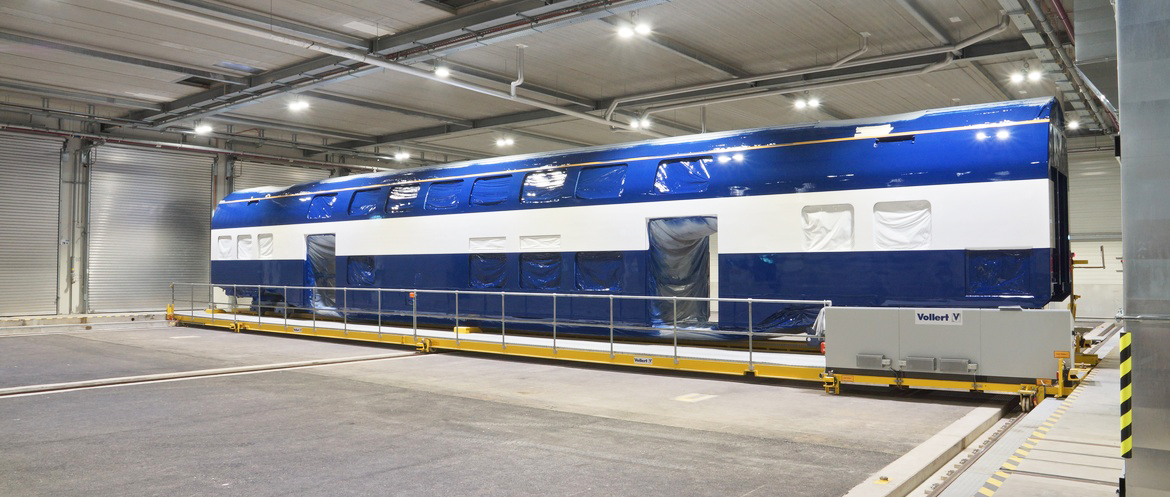
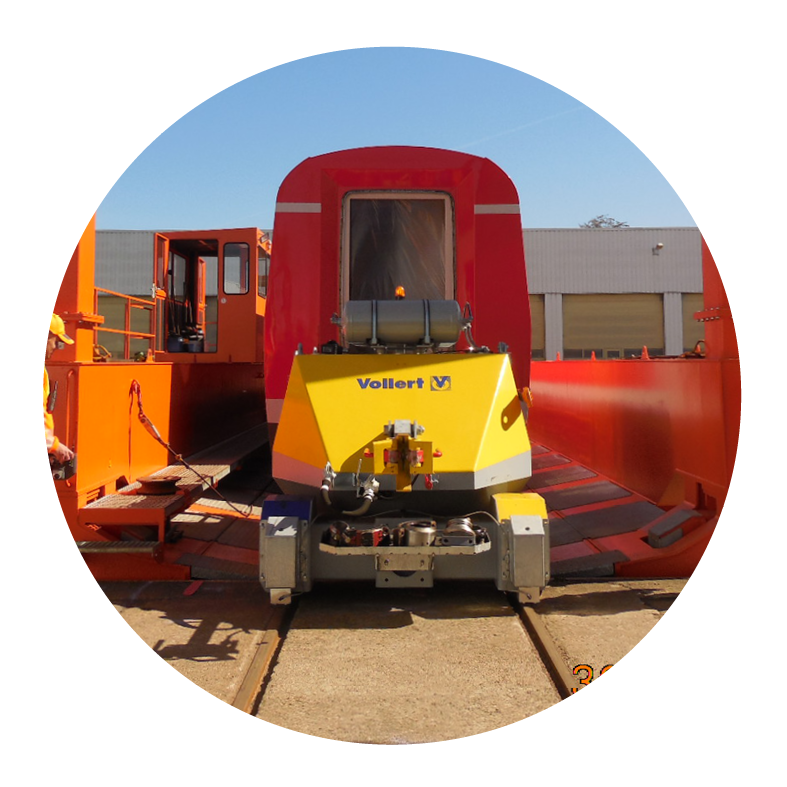

SG Ammendorf modernizes workshop logistics with a travelling platform and a road-rail vehicle from Vollert


Where many tracks are concentrated in a small space — in maintenance shops, depots, railroad yards, and railcar manufacturing facilities — switching tracks becomes a matter of space. A switch yard that distributes a vehicle across dozens of tracks requires long switches, large radii, and space that is rarely available on a factory site. Furthermore, each switch increases maintenance costs and shunting time.
The travelling platform replaces the switch array with a single transverse movement: short travel distances, defined target positions, and a motion principle that can be automated and made safe. It picks up the vehicle or railcar, moves it perpendicular to the track direction in front of the target track, and sets it down there.
Heavy-duty travelling platforms for track switching
Vollert builds and modernizes travelling platforms for rail vehicles and railcars — as gantry-type trough transfer tables, indoor or outdoor transfer tables, recessed or above-ground, up to 40 m in length and with a load capacity of 200 metric tons. This allows rail vehicles and railcars to be moved between parallel tracks with minimal space requirements.
Heavy-duty travelling platfoms have proven their worth in a wide range of applications. They make track switching particularly flexible, whether in railroad depots or in rail vehicle manufacturing.
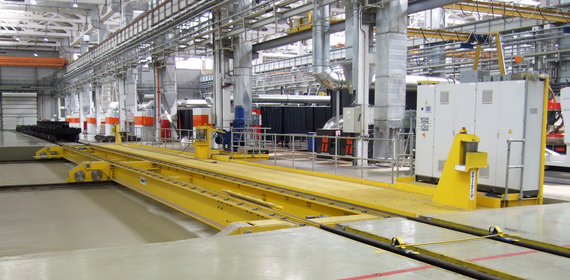
MAINTENANCE WORKSHOPS AND DEPOTS
In maintenance workshops and depots, rail vehicles must be moved regularly between storage, cleaning, maintenance, and repair areas. Heavy-duty travelling platforms connect numerous parallel work tracks in a space-saving manner and enable flexible, smooth vehicle transport — even in confined spaces.
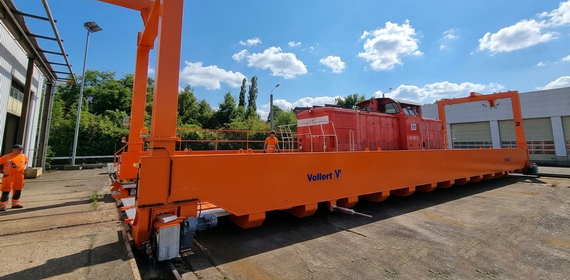
RAILWAY DEPOTS
At railroad depots, locomotives and railcars must be moved flexibly between storage, staging, and maintenance tracks. Heavy-duty travelling platforms enable the targeted distribution of rolling stock to different track areas and ensure efficient shunting operations while making optimal use of the available space.
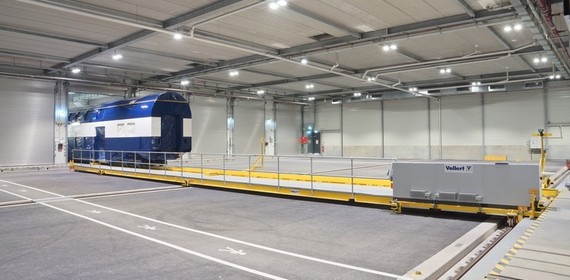
RAILCAR MANUFACTURING AND RAIL VEHICLE CONSTRUCTION
In railcar manufacturing and rail vehicle construction, heavy vehicle components and complete railcars pass through various production and assembly areas. Heavy-duty travelling platforms enable flexible transport between parallel production tracks, efficiently connect individual process steps, and ensure smooth material flows in production.
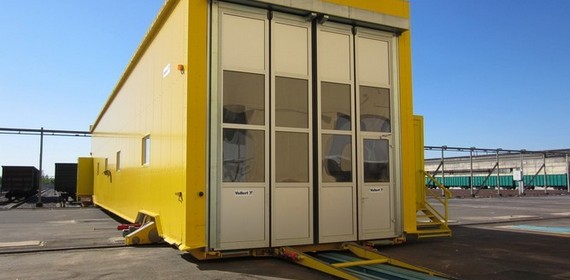
COMPONENTS: BOGIES AND WHEEL SETS
In the manufacturing and maintenance of bogies and wheel sets, heavy components must be transported safely and precisely between various machining, testing, and assembly stations. Heavy-duty travelling platforms enable flexible connections between parallel workstations and support efficient, space-saving processes.
A heavy-duty travelling platform is the ideal solution wherever heavy rail vehicles or components need to be moved flexibly between multiple parallel tracks. It enables a space-saving track connection, reduces the need for complex switch systems, and ensures efficient transport processes between different work and process areas.
Whether in workshops, manufacturing facilities, or maintenance depots — especially in situations with limited space and complex track layouts — a travelling platform offers decisive advantages.
When a travelling platform is the right solution:
Many parallel tracks: When workshop, storage, or production tracks must be accessible flexibly and without complex switch connections.
Limited space: When there isn’t enough room for traditional switch harps, long switches, or large track radii.
Chaining of different process steps: When body-in-white assembly, painting, assembly, testing, or maintenance take place on separate tracks.
Efficient track utilization: When multiple tracks need to be served by a central transport unit, and shunting movements and space requirements need to be reduced.
A travelling platform relies on the interaction between the platform body, the drive system, and the rail connection: The loaded platform body must be guided in a parallel path along the entire travel distance, come to a stop in front of the destination track, and safely transfer the vehicle to the connecting track.
The completed systems demonstrate how this is achieved in the project: At Siemens in Vienna, two drive units with absolute encoders maintain synchronized movement over a 90-meter travel distance; at SG Ammendorf, hydraulic track brakes secure the vehicle on the platform, swing bridges provide a ground-level crossing, and the platform is semi-automatically coupled to the existing tandem table. Operating modes in these projects range from radio remote control to semi-automatic operation to fully automatic operation with job order issuance and visualization in the control room.
Because the travelling platform serves as the link between the plant track and the work platform, it is best planned as part of the overall shunting concept: shunting vehicles or road-rail vehicles load and unload the platform, and the platform distributes the load to the tracks.
Whether it’s a portal-type trough-style travelling platform or a recessed travelling platform — the appropriate design depends on vehicle length, axle loads, the facility layout, weather conditions, and whether the platform is being built from scratch or an existing system is being modernized.
The following issues must be clarified in advance:
Which vehicles or railcars will be moved—length, axle load, total weight?
How many tracks must the transfer table connect, and how long is the travel distance?
Indoor facility or outdoor area; is a pit possible, or is an above-ground solution required?
How will the vehicle be moved onto the platform — using a shunting vehicle, a rail-road vehicle, or self-propulsion?
Manually, semi-automatically, or automatically with integration into the workshop or production control system?
New construction or modernization of an existing platform?

