Transport companies/
Rail vehicle construction
Rail vehicle construction


In public transit operations and rail vehicle manufacturing, shunting must fit precisely into tightly scheduled operational and workshop workflows: Vehicles are moved between route service, storage, cleaning, maintenance, and repair—often on compact track layouts with short track lengths, tight radii, and numerous switches.
In rail vehicle manufacturing, test runs and commissioning runs, as well as different vehicle types and conditions, add to the complexity, requiring particularly precise and flexible vehicle logistics.
High process reliability and availability
Vollert develops customized shunting and loading solutions that coordinate these complex processes safely and efficiently—from stationary shunting systems to shunting vehicles and road-rail vehicles. This enables reliable positioning of rail vehicles, short shunting times, and optimal integration of maintenance and production processes.
The result is high vehicle availability and stable operational processes that adapt to the individual requirements of depots, workshops, and vehicle production.
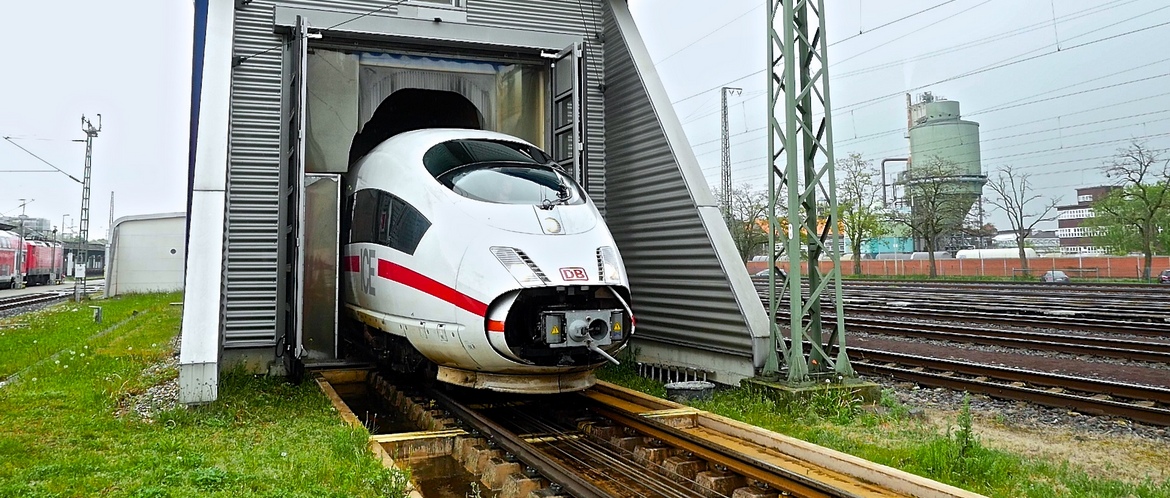
Public transportation is important for people because it ensures social participation, reduces environmental pollution (less CO2), promotes health (through active mobility), offer safety, and provide a more cost-effective, stress-free alternative to cars, enabling mobility for all population groups (including older people, people with disabilities, and people on low incomes) and reducing dependence on private cars. The same relevance applies to rail vehicle construction.
Shunting operations in a rail siding pose specific challenges.
Efficient shunting and loading
Shunting operations in a rail siding pose specific challenges. Heavy block trains dominate here, with vehicle availability, operational safety, cycle stability, and technical precision being the main priorities. A key feature of transport companies is the high degree of cycle and time criticality. Vehicles must be transferred from the depot to regular service on time in the morning and returned to the depot at night. Shunting processes often take place within tight time windows, for example between the end of operations and the start of maintenance.
Infrastructure: Track systems are often designed to be compact, with numerous switch connections, short track lengths, and limited escape and safety spaces. Shunting maneuvers are sometimes performed at low speeds and within visual range. In tram depots, there are also tight radii and special catenary configurations.
Mixed operation: Shunting, maintenance, and cleaning: Vehicles are not only parked, but also go through defined process chains. Interior cleaning, exterior washing, technical inspection, maintenance, or repair. In rail vehicle construction, test tracks, test benches, and commissioning runs are also added, which must be integrated into the shunting process.
Diversity: In rail vehicle construction, the challenge lies in the diversity of vehicle types and conditions. Some new vehicles are still in the commissioning process, software versions are not final, and braking systems are being tested. In addition, prototypes or pre-series vehicles are particularly sensitive, as damage can incur high costs.
Technical complexity: Digital train control and diagnostic systems, automatic couplings, or software-based vehicle configurations must be taken into account during shunting. Rearranging vehicles can, for example, have an impact on train configuration, software parameters, or diagnostic systems.
As an innovator and leading technology partner, Vollert develops economical shunting systems for branch lines and connecting railways in transport companies and in rail vehicle construction. We combine passion and expertise with forward-looking ideas to make logistics processes in freight loading reliable and efficient.
You don't just get our standard solution. We also develop a shunting and loading concept tailored to your specific track conditions, type of goods, and required tractive force—from stationary shunting systems and shunting vehicles to efficient road-rail vehicles.
 0
Shunting systems worldwide
0
Shunting systems worldwide
 0
Tons and more
0
Tons and more
 0
Years of expertise
0
Years of expertise


