
Agricultural industry


In the agricultural industry, rail transport must reliably keep pace with seasonal production and loading processes: Grain, seeds, feed, and fertilizer are moved in large quantities but are sensitive to moisture, contamination, and mechanical stress.
At the same time, silos, warehouses, and conveyor systems create complex track layouts, while high handling volumes and tight time windows must be managed, especially during harvest seasons.
Material flow between silos, warehouses, and rail
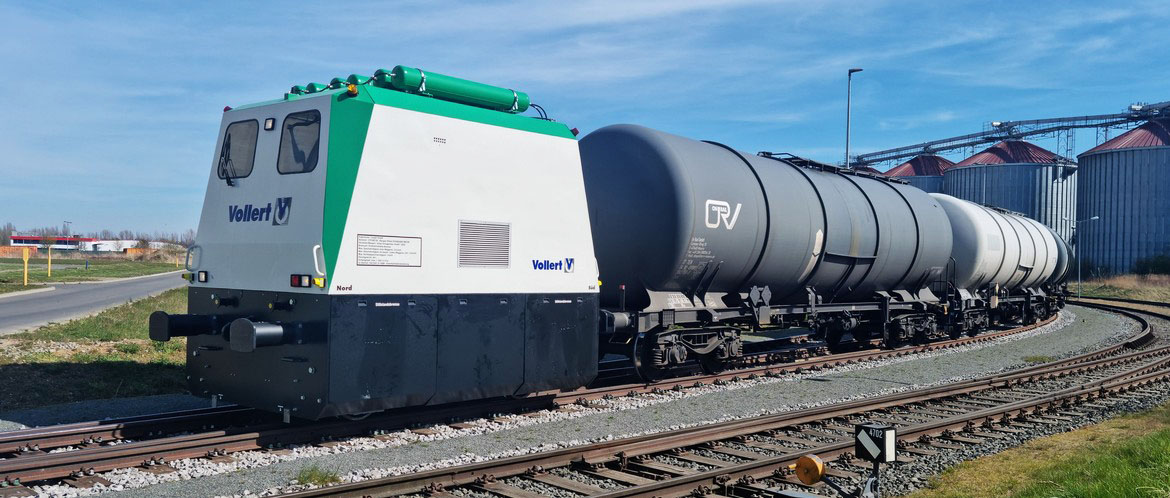
To address this, Vollert develops custom-designed shunting and loading solutions tailored to the cargo, track conditions, and required traction—ranging from stationary shunting systems to shunting robots and rail-road vehicles. This allows railcars to be positioned precisely and gently, loading processes to be efficiently automated, and seasonal peaks to be reliably managed.
The result is a seamless material flow between silos, warehouses, and rail—with high availability and minimal manual effort.
Agricultural production is essential because it provides people with essential food, creates the economic basis for billions of people (jobs, income), and plays a central role in maintaining landscapes and protecting the environment by providing raw materials, energy, and sustainable practices. Robust agriculture also ensures social stability and resilience to climate change.
Shunting operations in an internal rail connection in the agricultural industry pose specific challenges.
Efficient shunting and loading
The raw materials are very diverse, including grain, fertilizers, feed, seeds, and perishable goods. Each type of cargo requires different handling and storage conditions. Many agricultural products are also sensitive to mechanical impact, moisture, and temperature. Shunting must therefore be carried out gently and carefully to avoid damage and loss of quality.
Seasonal fluctuations: The agricultural industry is highly seasonal, which can lead to peak periods with high capacity utilization and increased activity. This requires flexible and efficient shunting solutions to avoid bottlenecks.
Storage and loading facilities: Internal rail systems often need to be connected to various storage and loading facilities, such as silos, warehouses, and conveyor belts. This can require complex track structures and precise shunting maneuvers.
Dust and dirt pollution: Handling agricultural products can lead to significant dust and dirt pollution, which poses additional challenges for the maintenance of track systems and vehicles.
Coordination with agricultural processes: Shunting must be closely coordinated with agricultural production processes, such as harvest time and transport to and from the fields. This requires precise planning and timing.
Sustainability and environmental regulations: There is increasing pressure in the agricultural industry to adopt environmentally friendly and sustainable practices. This may require the use of low-emission vehicles and the implementation of environmentally friendly operating procedures.
As an innovator and leading technology partner, Vollert develops economical shunting systems for branch lines and connecting railways in the agricultural industry. We combine passion and expertise with forward-looking ideas to make logistics processes in freight loading reliable and efficient.
You will not only receive our standard solution. We will also develop a shunting and loading concept tailored to your specific track conditions, type of goods, and required tractive force—from stationary shunting systems and shunting vehicles to efficient road-rail vehicles.
 0
Shunting systems worldwide
0
Shunting systems worldwide
 0
Tons and more
0
Tons and more
 0
Years of expertise
0
Years of expertise


