Automated intralogistics for Logan Aluminum


Aluminum does not tolerate handling errors: Soft surfaces, high material values, and delicate edges make every transport operation a quality risk — all the more so for coils that weigh up to 35 metric tons and are several hundred degrees hot.
Automated material flows at the aluminum plant
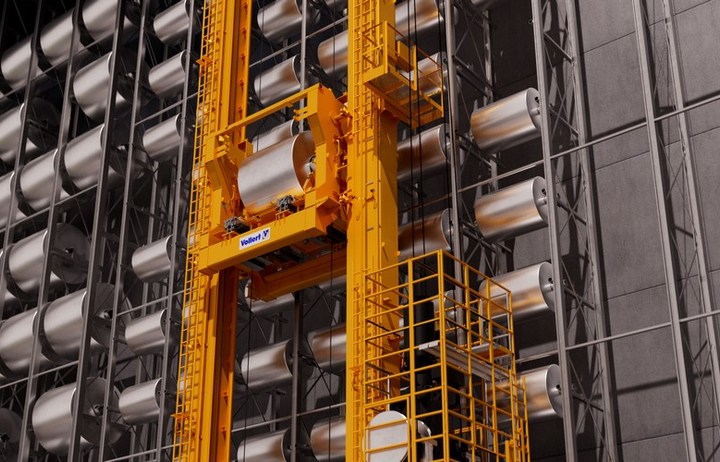
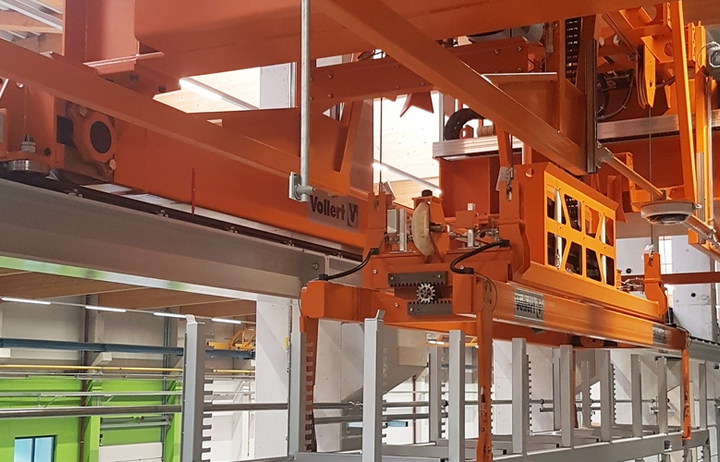
Vollert automates intralogistics across all stages of the aluminum production process—from primary production through the rolling mill to the extrusion plant and consistently designs load-bearing systems and motion profiles to ensure maximum surface protection. Intelligent storage, transport, and crane systems ensure a continuous flow of materials, reduce manual intervention, and provide maximum transparency regarding inventory and production processes.
The result is higher plant availability, shorter lead times, and cost-effective intralogistics that equally enhance product quality, process reliability, and efficiency.
Aluminum is a versatile, lightweight, and durable material that is used in numerous areas of life and industry. It is used in vehicle construction, aerospace, construction, the packaging industry, and electrical and energy technology. Due to its low weight, aluminum contributes to energy savings, for example in vehicles or in transportation, and thus supports more climate-friendly solutions.
Intralogistics concepts in the aluminum industry present specific challenges.
Efficient storage and transport
Although aluminum is comparatively light, it is also sensitive to mechanical impact. Surfaces can quickly become scratched or damaged, especially in the case of high-quality semi-finished products such as coils, plates, or profiles. In addition, the material is relatively soft and therefore susceptible to deformation. Storage systems and conveyor technology must therefore be designed in such a way that they can move heavy loads safely on the one hand, but also ensure gentle handling on the other, in order to avoid quality losses.
Diversity: Often, different semi-finished products such as slabs, continuous cast billets, coils, profiles, or sheets are processed, which vary greatly in size, weight, and geometry. This heterogeneity requires flexible storage and conveyor systems that can adapt to changing products and batch sizes.
Environmental conditions: Processes such as melting, casting, rolling, or extrusion involve high temperatures, dust generation, and sometimes harsh industrial conditions. The conveyor technology, sensors, and control systems used must be heat- and wear-resistant.
High throughput rates and tight cycle times: The material flow between the individual process steps must therefore be precisely coordinated to avoid downtimes or buffer overflows. This requires high-performance material flow systems that can react to changes in real time. The integration of warehouse management systems, production planning, and higher-level ERP or MES systems plays a central role here.
Safety requirements: Heavy loads, high temperatures, and automated motion sequences place increased demands on personnel and equipment protection. Appropriate safety concepts, clear traffic routes, and modern monitoring systems are an integral part of a functioning intralogistics concept.
Intelligent material flow systems ensure smooth interfaces and fast, reliable transport and storage processes between the machining and processing steps in aluminum production. This requires a great deal of know-how to design the process chain productively and also to create the ideal software architecture.
The expertise we have built up over more than 40 years of customer projects worldwide. Numerous well-known customers from the aluminum industry rely on our proven intralogistics concepts for the economical production of high-quality foil, sheet or extrusion profiles for the automotive, aerospace or medical industries.
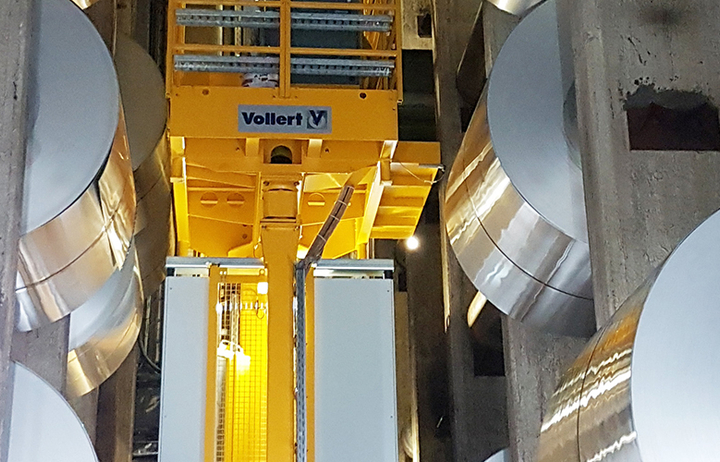
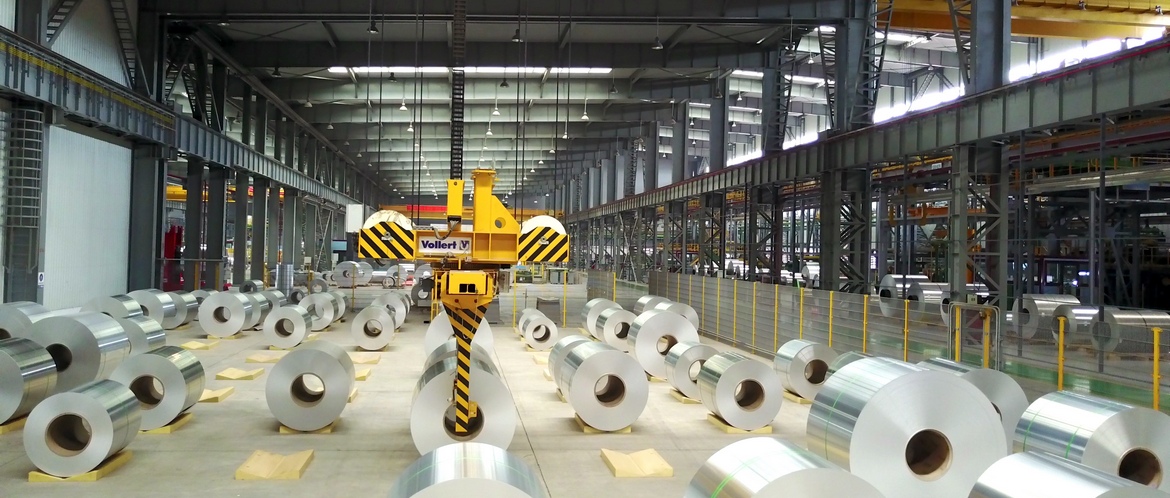
For the cost-effective production of high-quality aluminium products such as foils, strips or sheets, the optimum integration of the various production processes in rolling plants is crucial. This requires fully automated intralogistics solutions to ensure resource-saving and efficient workflows. From automatic crane systems for the raw aluminium ingots and the logistical linkage of hot and cold rolling mills, through to intelligently designed transport and storage systems for aluminium coils weighing up to 35 tons and at temperatures of several hundred degrees, which are particularly susceptible to damage from the outside.
That we meet these requirements perfectly has already been successfully proved by Vollert in an impressive number of international projects:
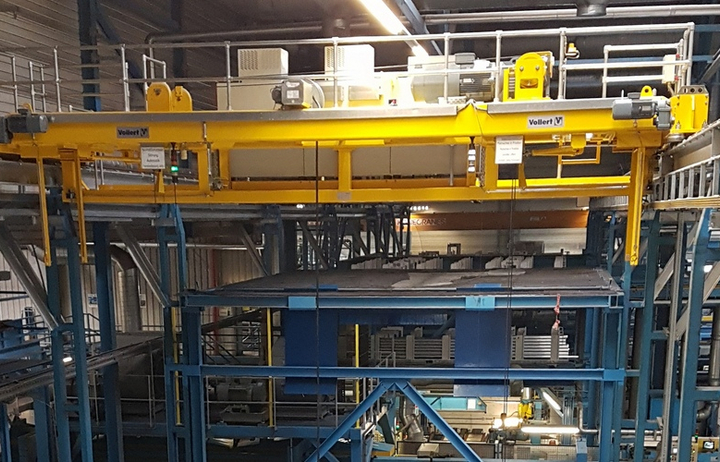
Whether in the form of window frames, vehicle trim strips or football goal posts - we frequently come across aluminium profiles in everyday life. What they have in common is the production method: they are pressed as up to 50-metre long extruded profiles from aluminium billets, cut to transportable lengths of between six and eight metres and automatically stacked in transport skips. Depending on the desired end product, the profiles can be hardened in ageing ovens, refined by anodizing or powder-coating.
In order to avoid bottlenecks, the intralogistics systems from Vollert ensure smooth-running processes and perfect interlinking of the individual production stages:
In aluminium primary production, the requirements for storage and transport systems are particularly high. Additionally, the aspect of environmental protection and resource saving must be taken into account. We have precise knowledge of the environment and ensure durable and future-proof processes and transport systems.