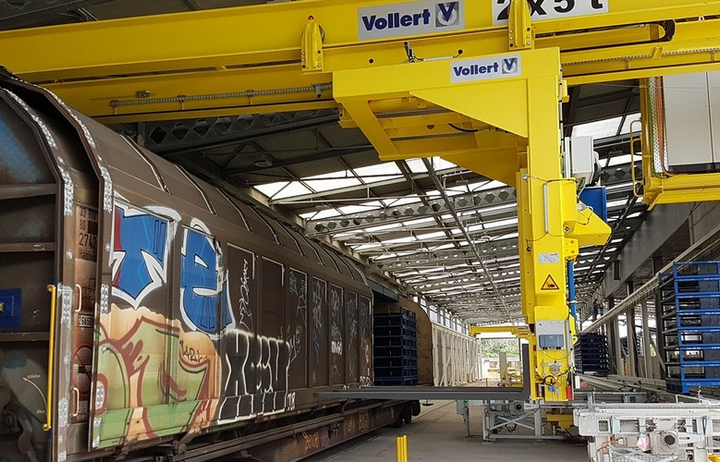
Automated train loading at ŠKODA with Vollert train handlers


The electrification of cars, port vehicles, and industrial transport systems is placing fundamentally new demands on intralogistics. Batteries for passenger and commercial vehicles, AMRs, and port handling equipment weigh several metric tons. In the assembly of electric vehicles and commercial vehicles, in the production of lithium-ion batteries, or during the replacement of battery modules for charging, there can be no compromises when it comes to availability and process reliability.
Automated logistics for battery modules
Vollert develops and implements logistics systems that safely, precisely, and seamlessly integrate the handling, loading, and storage of battery packs and modules weighing 5 metric tons or more into production processes: automated exchange stations, stacker cranes for battery storage, specialized crane systems, and automated guided vehicles (AGVs) that work together as an integrated system architecture.
Battery systems for electric vehicles, port equipment, or industrial AMRs are not off-the-shelf products. They are heavy, geometrically complex, electrically sensitive, and must be handled in tightly synchronized processes with a high degree of repeatability. A battery basket for a container AMR or a traction module for a commercial vehicle can weigh between 5 and 20 metric tons—and yet must still be positioned with millimeter precision, securely locked in place, and reliably transferred.
Added to this is the operating environment: battery replacement stations in ports, logistics centers, or production facilities are often in operation around the clock. Outages have a direct impact on vehicle operations and, consequently, on the entire handling or production process. This also applies to battery logistics in automotive production or battery cell manufacturing. Availability, redundancy, and maintainability are therefore not secondary considerations, but rather systemic requirements from the very beginning.
Standard crane systems or conventional stacker cranes are not designed for this combination of weight, precision, cycle time, and operational safety. Battery logistics systems require their own system logic—and a partner who develops this logic based on the process itself.


When multiple battery units need to be buffered, charged, and sorted by charge level, a structured storage system is required. Vollert storage and retrieval machines for battery systems are designed to handle the specific weights, dimensions, and handling requirements of traction batteries. They enable space-saving, organized storage with fast access and full traceability—and when access frequency is not particularly high, satellite warehouses are particularly well-suited for this purpose.


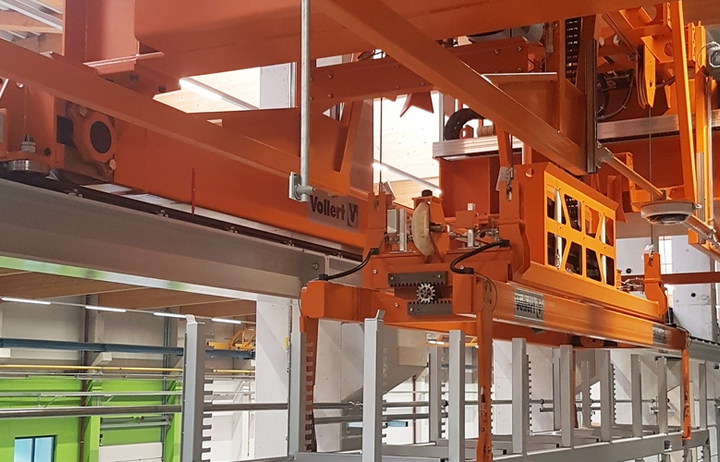
In production environments—such as during the assembly of electric vehicles or in battery cell manufacturing—battery modules must be precisely positioned, installed in vehicles, or moved between production stations. Special crane systems from Vollert handle this task using customized load-handling attachments, defined positioning accuracy, and process-integrated control logic. They are also used as loading and unloading crane systems for rail transport of battery modules.


Roller conveyors and chain conveyors form the backbone of automated battery logistics systems. They transport heavy battery modules and battery systems safely, precisely, and efficiently between the individual process steps. Thanks to their robust design for heavy loads, modular construction, and intelligent control systems, they enable a reliable material flow, short cycle times, and seamless integration into production and assembly processes.


Battery exchange stations are essential when vehicles or devices need to be quickly and reliably supplied with freshly charged batteries while in operation. Vollert implements fully automated swap stations where discharged batteries are removed, stored on charging racks, and charged units are automatically dispensed—without manual intervention, with high repeatability, and in short cycle times.
Reference projects such as the battery replacement station at the Maasvlakte Rotterdam container terminal demonstrate how these systems function under real-world, high-load conditions: multiple AMRs operating in parallel, fully automated battery replacement, integration into vehicle control systems, and precise delivery.
Autonomous Mobile Robots (AMR) in the battery industry Autonomous Mobile Robots (AMR) in the battery industry
Autonomous guided vehicles (AGVs) complement the battery handling system in areas where batteries need to be transported between the swap station, the charging area, and the staging zone. Vollert AGVs are designed for heavy-duty applications and can be seamlessly integrated into the overall architecture of the battery handling system.
Battery logistics systems must meet the highest standards for performance, precision, and availability. Depending on the application, they handle batteries weighing from 2 to over 20 metric tons and position them with an accuracy of up to ±5 mm. Short changeover cycles, reliable 24/7 operation, comprehensive safety features, and seamless integration with vehicle, charging, and warehouse management systems are critical requirements.
What battery weights and dimensions are being handled?
How many change cycles per shift or day are required?
How many battery units are buffered and charged simultaneously?
What are the requirements for positioning accuracy and handover logic?
Is an interface to the vehicle control system and charging infrastructure required?
What are the availability requirements for overall operations?
Vollert’s battery logistics systems are not limited to a single industry. The need for safe, precise, and process-integrated handling of battery systems weighing several metric tons arises wherever electric mobility intersects with industrial operating environments.

PORT LOGISTICS AND TERMINAL HANDLING
Port forklifts, reach stackers, and automated container vehicles are increasingly being electrified. Their traction batteries must be replaced during operation without interrupting the handling process. Vollert has developed and implemented fully automated battery exchange stations for this application, which operate reliably under the extreme availability requirements of port operations.

PASSENGER CAR AND COMMERCIAL VEHICLE MANUFACTURING
In the assembly of electric vehicles and commercial vehicles, battery modules must be installed into vehicle structures with high precision. Special crane systems and customized load-handling devices from Vollert handle, among other tasks, the delivery and loading of battery modules weighing several metric tons from rail transport into production, integrated into the assembly cycle with process reliability and repeatable accuracy. Vollert also supplies complete storage and conveyor systems to ensure optimal material flow between production areas.

BATTERY CELL MANUFACTURING AND GIGAFACTORIES
The production of lithium-ion batteries creates new demands on internal material flow: battery cells, modules, and packs must be transported, buffered, and made available between production stages. Vollert develops intralogistics solutions that address these requirements in highly automated production environments.

INDUSTRIAL AMR FLEETS AND INTERNAL LOGISTICS
Companies that operate large fleets of electric industrial trucks or AMRs require a structured charging infrastructure with automated battery management. Vollert systems enable fully automated battery replacement as well as the organized storage and charging of multiple battery units in parallel.
Heavy-duty intralogistics projects are always unique. Different loads, material properties, production processes, and space constraints require customized solutions. Consequently, numerous challenges arise even in the early stages of a project. Below, our experts answer the most common questions from the field regarding battery logistics systems — based on decades of experience with automated solutions for a wide range of industries.
What battery weights are Vollert's battery logistics systems designed to handle? What battery weights are Vollert's battery logistics systems designed to handle?
Vollert develops battery logistics systems for batteries weighing from approximately 2 metric tons to over 20 metric tons. The specific system design is always tailored to the project and takes into account factors such as vehicle type, battery format, dimensions, replacement frequency, and the respective operating and environmental conditions. Future requirements—such as larger battery systems or increased handling capacities—can also be factored into the planning stage. This customized design results in high-performance and safe handling solutions for automated transport, storage, and battery replacement in demanding industrial applications.
Can battery logistics systems be integrated into existing operational environments? Can battery logistics systems be integrated into existing operational environments?
Yes. Vollert has extensive experience integrating battery logistics systems into existing operational and production environments. Its range of services includes both brownfield projects involving existing buildings, facilities, and processes, as well as complete greenfield construction projects. As early as the concept phase, we analyze facility geometries, support structures, safety requirements, and existing material flow and IT systems. Based on this analysis, we develop a customized system solution that integrates seamlessly into the existing infrastructure and minimizes disruption to ongoing operations.
What safety requirements are taken into account in battery logistics systems? What safety requirements are taken into account in battery logistics systems?
Handling high-voltage batteries poses special challenges in terms of safety and process stability. That is why Vollert takes all relevant safety aspects into account right from the system planning stage. These include, among other things, safe electrical isolation during transfer processes, intelligent interlocking and release concepts, fire protection measures for lithium-ion batteries, and defined emergency and evacuation scenarios in the event of malfunctions or system failures. These measures are complemented by coordinated control and monitoring systems. The result is battery logistics solutions that meet the highest standards for occupational safety, system availability, and process reliability.
How does Vollert differ from standard suppliers in the crane and stacker crane manufacturing industry? How does Vollert differ from standard suppliers in the crane and stacker crane manufacturing industry?
Vollert develops battery logistics systems not as standardized product solutions, but as custom-designed integrated systems. The focus is on the optimal coordination of all components—from mechanics, conveyor technology, and load-handling devices to control systems, automation, and IT integration. This results in solutions that are precisely tailored to the respective battery formats, material flows, and operational processes. Unlike traditional manufacturers of cranes or stacker cranes, Vollert does not focus on individual machines but rather on the entire logistics process. The result is cost-effective, safe, and future-proof systems for the automated handling of heavy traction batteries.