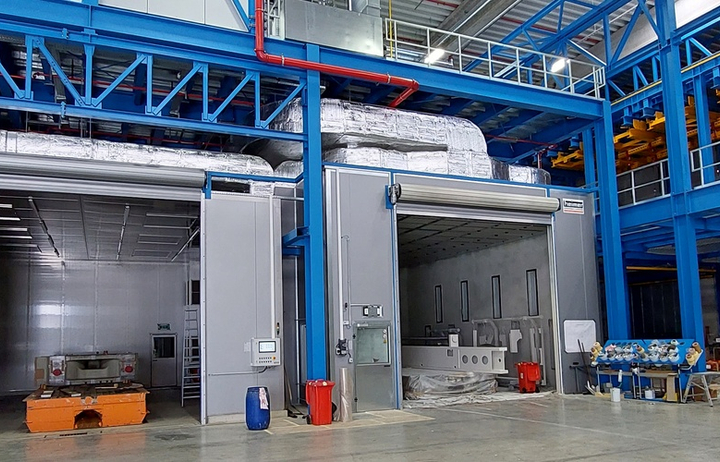
Paint shop for agricultural machinery from JACTO


The surface coating of heavy workpieces and large components places demands on conveyor technology that go far beyond those of traditional painting processes. Loads weighing several metric tons must be guided precisely through pretreatment, dip tanks, dryers, and paint booths—without delays, without damage, and, above all, with customized sequences due to widely varying cycle times. At the same time, the variety of components is greater in the heavy-duty sector, and quality requirements are different.
Cost-effective conveyor technology in paint lines
Vollert develops material handling systems that make this complexity manageable. Not as individual components, but as a comprehensive material flow architecture that considers production logic, plant geometry, and interfaces as a unified whole. The result is painting lines with integrated process and automation technology that ensure high plant productivity, short throughput times, and stable processes—even as demands continue to grow.


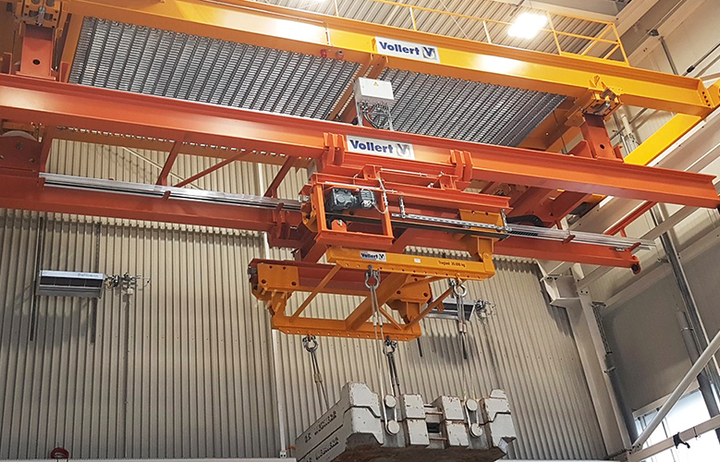
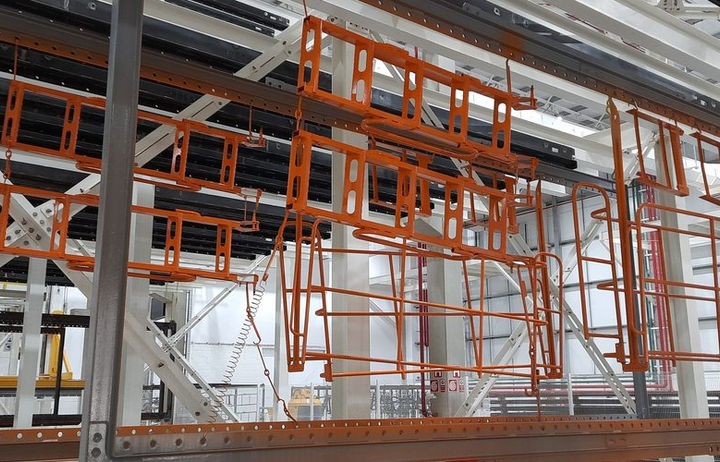
Ceiling-guided shuttle technology enables the automated transport of heavy workpieces. The conveyor technology includes circulating systems with loading and unloading systems, longitudinal conveyor technology, distribution manipulators, and lifting, rotating, and swiveling devices for workpiece carriers. Automatic cranes supply the process stations with transport units. Functional workpiece carriers (skids) incorporate rotation, swivel, and height adjustment functions to ensure defined workpiece positions in pretreatment and painting processes.


In many heavy-duty paint lines, floor-based conveyor technology forms the backbone of the continuous material flow. The systems used include recirculating systems with roller conveyors, cross-travel distribution and lift carts, rotary and swivel tables, and chain conveyors for paint carts. Central push platforms handle the supply and removal of materials from the process stations, while push-pull systems ensure the cycled or continuous flow of materials through the blasting, cleaning, painting, flash-off, and drying areas.
Lifting tables, vertical conveyors, and diving devices Lifting tables, vertical conveyors, and diving devices


Precise, controllable up-and-down movements are crucial for immersion processes in pretreatment or cathodic dip coating (KTL). Immersion speed, dwell time, and the movement as the workpiece emerges directly influence coating quality. Vollert systems set the standard today when it comes to transporting workpieces—whether suspended or floor-guided, and moving transversely or longitudinally—through the immersion tank. Loading and unloading handling systems for transferring workpieces to and from the coating carriages, as well as immersion manipulators and immersion crane systems (stationary and mobile), are available.
Heavy-duty material handling technology for surface coating systems is not a niche topic. It is a critical production factor in a wide range of industries—anywhere large or heavy components require a specific surface quality and where painting processes are closely integrated into the production workflow.
AUTOMOTIVE AND COMMERCIAL VEHICLE INDUSTRY
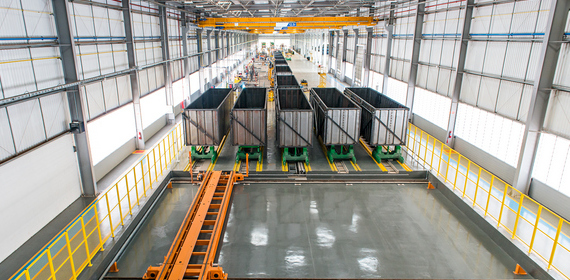
Car bodies, frames, axles, and chassis components must be coated in high volumes, often with varying cycle times and in multiple color variants. At the same time, component weights and dimensions are increasing, particularly in the commercial vehicle sector. Vollert implements conveyor systems that reliably meet these requirements even as the variety of variants increases. Rigidly interlinked conveyor systems cannot meet these requirements.
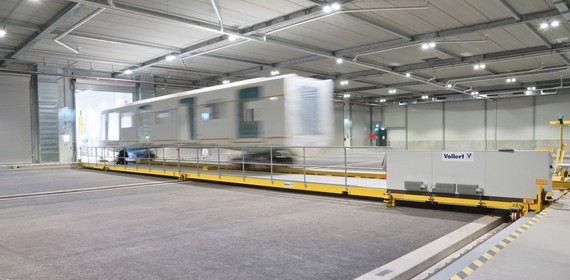
RAIL VEHICLE AND TRANSPORTATION TECHNOLOGY
Bogies, car bodies, and large components used in rail vehicle manufacturing require material handling systems designed to handle extreme dimensions and weights. At the same time, surface protection and coating quality are critical to safety in this sector. Vollert brings experience from real-world projects to this field, where component weights of 20 metric tons and more are standard requirements.

DRIVE TECHNOLOGY AND MECHANICAL ENGINEERING
Large gearboxes, motor housings, hydraulic components, and machine frames require coating processes designed for individual production runs, heavy weights, and complex geometries. Vollert has completed landmark projects in this segment, including systems for one of the world’s largest drive manufacturers.

AGRICULTURAL TECHNOLOGY AND AGRICULTURAL MACHINERY
Frames, cabs, axles, as well as attachments and components for tractors, combine harvesters, and other agricultural machinery require material handling systems capable of handling large components, heavy workpieces, and a wide variety of configurations. At the same time, coating systems must be flexible enough to adapt to different product lines and batch sizes. Vollert implements heavy-duty conveying systems that meet these requirements with high process reliability, precise positioning, and maximum system availability.
Heavy-duty material handling in surface treatment is not a transportation problem. It is a process problem. Every movement of a workpiece—whether during blasting, in pretreatment, through the immersion bath, into the dryer, or into the paint booth—is part of a chemical, thermal, or mechanical process step. Timing, positioning accuracy, and motion characteristics directly influence coating quality.
For heavy workpieces weighing two metric tons or more, and for large components used in commercial vehicle, rail vehicle, or mechanical engineering applications, additional requirements come into play: load capacities that exceed the limits of standard conveying technology; component geometries that require special suspensions or support frames; process environments with aggressive media, high temperatures, or explosion-proof zones that place special demands on material selection and drive technology.
Anyone planning conveyor systems in this environment must consider the painting process, material flow logic, control and monitoring technology, and system architecture as a unified whole. This is precisely the approach that Vollert consistently pursues in projects with renowned manufacturers from the automotive, commercial vehicle, transportation technology, and drive industries.
Often, the task at hand is not to build a new paint line from scratch on a greenfield site. Rather, it involves expanding or modernizing existing facilities, or adapting them to changing production requirements. It is precisely this situation that places special demands on conveyor technology.
In brownfield projects, new conveying elements must be integrated into existing plant structures, existing process baths, ongoing production cycles, and existing control architectures. At the same time, the retrofit must disrupt ongoing operations as little as possible. This requires a planning methodology that consistently combines an assessment of the current state, interface analysis, and implementation planning. Vollert brings particular strengths to brownfield projects: through systematic analysis of existing plants, through modular system architectures that can be integrated step by step, and through experience in coordinating retrofit measures during ongoing operations. This results in solutions that are not only technically sound but also function effectively in real-world production environments.
Projects for heavy-duty paint lines rarely fail due to a lack of willingness to invest. Problems more often arise when process requirements are underestimated, interfaces are considered too late, or system architectures are designed with too narrow a scope.
Planning conveyor systems and the painting process separately Planning conveyor systems and the painting process separately
Anyone who plans material handling and the coating process independently of one another risks inefficiencies at the interfaces. Conveyor speed, immersion and lifting movements, dwell times in the individual process stages, and cycle times must be precisely coordinated. The positioning accuracy of the product carriers also influences coating quality and plant output. If these parameters are not integrated until a late stage of the project, time-consuming adjustments are often unavoidable. Integrated planning of material flow and process technology, on the other hand, lays the foundation for stable, economical, and high-performance plant operation.
Setting load profiles too conservatively or too optimistically Setting load profiles too conservatively or too optimistically
Designing heavy-duty material handling systems based on average values often leads to miscalculations. If load capacities are set too low, this can result in overloads, increased wear, or unplanned downtime. An oversized system, on the other hand, results in unnecessarily high investment and operating costs. It is therefore crucial to conduct a realistic analysis of the actual workpiece weights, dimensions, centers of gravity, and cycle time requirements—including future product variants. Properly sized buffer zones also help balance out load peaks and ensure a continuous flow of material.
Conveyor systems in surface coating plants are exposed to extreme environmental conditions. Aggressive chemicals in pretreatment baths, high temperatures in drying and curing ovens, moisture, and potentially explosive areas in paint booths place high demands on the design and components. Materials, corrosion protection, drive technology, sensor systems, and controls must be precisely tailored to these operating conditions. If these factors are taken into account as early as the planning phase, breakdowns can be prevented, maintenance costs reduced, and the service life of the entire conveying system significantly extended.
Production programs are constantly changing. New workpiece geometries, additional color options, smaller batch sizes, or increasing demands for customization require flexible conveyor systems. If a system is designed exclusively for the current product range, later expansions often involve significant effort. For this reason, capacity for future developments should be factored in as early as the concept phase. Modular conveyor systems, flexible product carriers, and adaptable control concepts make it possible to cost-effectively adjust production capacities and processes to new market requirements at a later stage.
Treat maintainability and availability as secondary considerations Treat maintainability and availability as secondary considerations
Unplanned downtime in paint lines results in significant costs. In addition to production losses, workpieces that have already been coated may be damaged, or entire process chains may come to a standstill. For this reason, ease of maintenance and system availability should be part of the system planning from the very beginning. This includes easily accessible components, redundant drives at critical points, modern diagnostic systems, and predictive maintenance concepts. An intelligent plant architecture reduces unplanned downtime, simplifies service work, and ensures the safe and economical long-term operation of the entire coating plant.