From 5 to 50 tons -
we move it.
we move it.


Traditional intralogistics often ends at 2–3 tons. But what happens when 20, 40, or 50 tons need to be moved safely, precisely, and efficiently? Safety requirements increase exponentially, and special solutions are expensive and inflexible. The heavier the load, the higher the project risk. This is exactly where we come in.
We move what others cannot
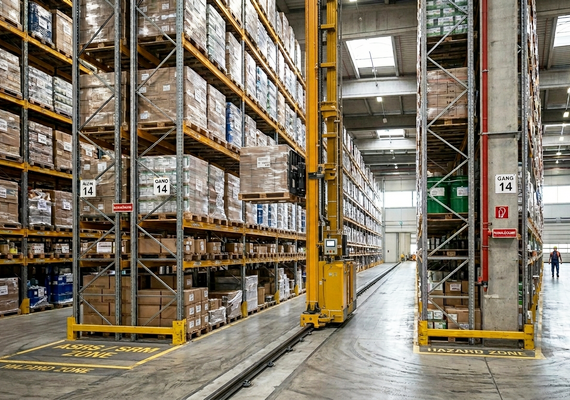
When it comes to intelligently networked material flow, storage, and packaging concepts for heavy loads and large parts, numerous market leaders worldwide rely on our plant and machine technology. Standard solutions reach their limits here, but we offer decades of experience in heavy-duty intralogistics concepts as well as maximum planning reliability, scalability, and reliable facts. We offer turnkey intralogistics systems for optimally integrated production processes.
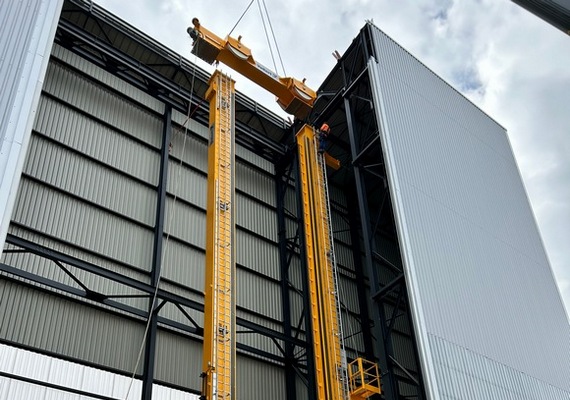
Whether fully automated mega high-bay warehouses for aluminum coils, intelligent material flow systems for leading aluminum extrusion manufacturers, the world's most powerful storage and retrieval machines for sheet metal storage, automatic crane systems, or state-of-the-art surface coating systems—Vollert is involved in all of these areas. We don't just move heavy loads; above all, we ensure high system productivity and efficient processes.
 0
Intralogistics systems worldwide
0
Intralogistics systems worldwide
 0
Tons and more
0
Tons and more
 0
Years of expertise
0
Years of expertise
Heavy-duty intralogistics differs fundamentally from traditional material handling solutions. When loads of 5 tons or more are being moved, not only do load capacities and safety requirements increase, but so do the demands for precision, availability, maintainability, and process integration.
In many projects, it is not simply a matter of transporting heavy goods from A to B. It is about integrating sensitive or large loads into tightly scheduled production environments, reliably controlling material flows, and simultaneously keeping an eye on space efficiency, access speed, and operational safety. Standard solutions reach their limits in this environment. That is why heavy-duty intralogistics requires a systemic approach that considers material, process logic, building layout, interfaces, and operational goals together.
In a small-parts warehouse, storage and retrieval machines often handle loads ranging from a few kilograms to several hundred kilograms. In heavy-duty intralogistics, however, individual loads can weigh several tons or even up to 50 tons. This changes all requirements for load-bearing structures, steel construction, drive technology, dynamics and acceleration, braking distances, and foundation design.
Even small movements generate enormous forces. Systems must therefore be designed to be significantly more robust, torsionally rigid, and precise.
Small parts or pallets usually conform to standard dimensions. Large parts, on the other hand, often vary considerably. They may have different lengths, asymmetrical geometries, shifting centers of gravity, sensitive surfaces, or variable load capacities.
This results in specific requirements for storage and conveyor technology. Many heavy-duty systems are therefore developed on a project-specific basis rather than implemented as standard solutions.
In traditional distribution warehouses, maximum speed is often the priority. In heavy-duty intralogistics, however, controlled dynamics take center stage.
Heavy loads possess enormous inertia. Rapid acceleration or abrupt braking can lead to material damage, pendulum-like movements and vibrations, unstable load conditions, or increased wear.
For this reason, motion profiles are designed with significantly greater precision. Often, controlled and stable motion is more important than sheer travel speed.
While pallet conveyor systems are often modular in design, heavy-duty conveyor systems are usually customized to the specific application and load profile.
Examples include transfer cars, heavy-duty shuttles, chain conveyors, roller conveyors, automatic crane systems, driverless heavy-duty vehicles, heavy-duty stacker cranes, and special load-handling devices.
The challenge lies in moving heavy loads precisely, safely, and at the same time in a way that protects the material.
The heavier the load, the higher the demands on safety and process control. Even minor missteps can cause massive damage to materials, equipment, or infrastructure.
In many cases, automation also replaces dangerous manual transport operations with cranes or forklifts.
That is why the following topics, among others, play a central role:
Collision protection
Safe positioning
Load monitoring
Redundant safety systems
Controlled motion profiles
Defined safety zones
Traditional warehouse solutions are often based on standardized components and layouts. Heavy-duty intralogistics, on the other hand, is usually highly customized.
Each system must be individually tailored to workpiece types, production processes, the building structure, material flow, safety requirements, and future expansions.
That is why simulation, engineering expertise, and interdisciplinary planning play a much greater role than in many standard warehouse projects.
Investments must be compelling not only from a technical standpoint—but also from an economic one.
A modern heavy-duty intralogistics system is far more than just a new warehouse or conveyor system. It is an investment in the future viability of your company. That is why at Vollert, the focus is not solely on the technical solution, but above all on its economic benefits.
Together with our customers, we develop intralogistics systems that accelerate processes, use resources more efficiently, and reduce costs in the long term. The result is measurable improvements along the entire value chain—from material staging through production to shipping. Because in the end, what counts isn’t the number of cranes or conveyor lines, but the contribution to the company’s success.
When efficiency can be measured in Euros
Rising labor costs, a shortage of skilled workers, high energy prices, and growing production demands are putting companies under increasing pressure. At the same time, investments today must generate demonstrable added value faster than ever before.
Intelligent heavy-duty intralogistics delivers exactly this added value. Automated material flows reduce unproductive transport times, eliminate wait times between manufacturing processes, and ensure that materials are available at the right place and at the right time. At the same time, manual interventions, error rates, and unplanned downtime are reduced. Technical improvements yield economic benefits that are evident every day.
Economically optimized intralogistics simultaneously influences numerous cost and performance factors:
A Vollert solution is not simply an investment in new warehousing or conveying technology. It is an investment in greater productivity, lower process costs, and increased competitiveness. That’s why we take a holistic approach to every project: We analyze material flows, identify cost-saving opportunities, and develop solutions that pay off in the long term—both technically and economically. Every investment decision starts with asking the right questions.
Together, we analyze, among other things:
Based on this, an economically sound system concept is developed that takes both technical and business objectives into account.
Production reliability starts with a material flow you can count on at all times. This shifts the focus away from the technology and onto what really matters: production that runs reliably, meets deadlines, and operates cost-effectively. This value proposition aligns perfectly with the previously discussed topics of capacity expansion, ROI, the skilled labor shortage, and digitalization. Together, they establish a consistent positioning of Vollert as a partner for secure, high-performance, and future-proof production processes—going far beyond traditional plant engineering.
At the same time, efficient production processes aren’t built on assumptions, but on reliable information. Digital intralogistics solutions provide relevant process data in real time and lay the foundation for continuous improvement.
Growth requires space—but not necessarily new buildings. Rising production volumes, larger inventories, and higher demands on delivery capabilities are pushing many companies to their capacity limits. Warehouse space is fully utilized, transport routes are getting longer, and valuable production space is increasingly being used for temporary storage. At the same time, available land is scarce, new construction is costly, and permitting processes are time-consuming. Yet the greatest potential often lies within existing buildings.
Vollert develops intelligent heavy-duty intralogistics solutions that enable companies to use their existing space much more efficiently. Automated storage, conveyor, and crane systems create additional storage capacity, faster material flows, and more production space—without the need for new facilities or additional land.
Depending on the initial situation, storage capacity can be increased by 30 to 100 percent, material flows can be significantly accelerated, and existing infrastructure can be utilized much more effectively. In this way, companies lay the foundation for further growth and increasing production volumes without having to undertake extensive construction projects.
In many manufacturing facilities, the company is growing faster than the existing infrastructure can keep up. And every square meter of production space incurs investment and operating costs. This makes it all the more important to use that space as efficiently as possible.
The following space-saving opportunities can be realized:
With intelligently planned intralogistics, material flows are reorganized, warehouse concepts are optimized, and existing space is utilized efficiently. This transforms a limited space into a high-performance production site with long-term growth potential.
Simply schedule your personal consultation with our sales experts today!
With our new appointment booking feature, you can view the calendar of your preferred contact directly and easily select a convenient time slot. This allows you to receive personalized advice quickly and easily—directly from our experts. Take this opportunity to discuss your project inquiries in person, discover customized solutions, and gain valuable first-hand insights. Whether you have initial questions, specific plans, or detailed project discussions—we’re here for you.
Select your contact person, secure your preferred appointment, and benefit from personalized advice on equal terms. We look forward to speaking with you!