Second transformer plant with fully automated cantilever storage system for steel coils in China


In transformer manufacturing, the flow of materials determines quality and output. The raw material is thin, delicate, and comes in many widths and diameters. At the same time, multiple cutting lines need to be reliably supplied in the correct order. A storage system that merely saves space does not solve the problem. What is needed is a system in which storage, transport, and control work together.
Automated intralogistics in transformer manufacturing
Vollert integrates high-bay warehouses, stacker cranes, travelling platforms, automated guided vehicles, and control software into a seamless material flow: from goods receipt to the cutting line. The scope of services ranges from process analysis through system design, structural analysis, engineering, manufacturing, and assembly to commissioning and lifecycle support.

A high-performance logistics system for transformer manufacturing must do far more than simply store heavy slit strips safely. It must make the material available as needed, account for different strip geometries and weights, and precisely coordinate the supply to the cutting lines with the production processes. The key, therefore, is the seamless interaction of all components—from compact storage and automated transport to intelligent control.
This results in an automated material supply system that efficiently utilizes transport routes and buffer areas, reduces manual intervention, and supports a reliable production flow—from goods receipt to material delivery at the cutting line.

CANTILEVER HIGH-RACK STORAGE FOR SLIT COILS
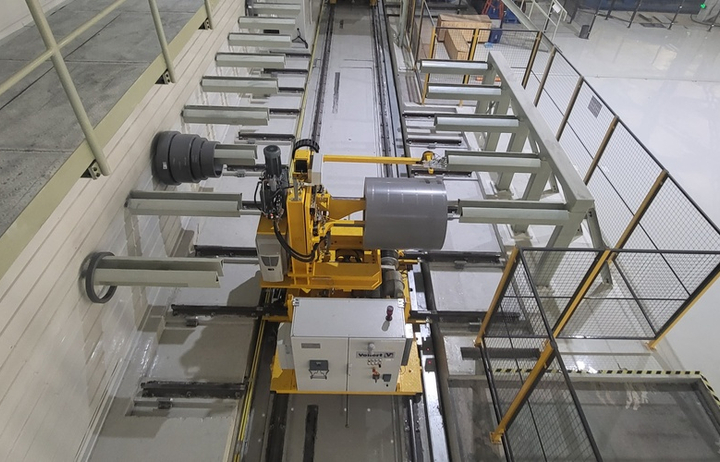
Cantilever arms support the strip where it is least vulnerable: at the coil eye. In a high-rack design, this creates a compact, fully automated, high-density storage system. Cantilever racks and high-bay racking are not alternatives: the cantilever rack is the storage system, while the high-bay racking is the storage architecture. The software distributes the strips to storage locations based on weight and geometry, thereby making optimal use of the cantilever racks.

STACKER CRANES AND LOAD HANDLING
Stacker cranes handle storage and retrieval, separation, package formation, and weighing. Special coil grippers grasp the strip by the eye and deposit it at defined transfer points. Multiple rack-feeding machines working in tandem ensure that production runs around the clock.

TRAVELLING PLATFORMS AND CONVEYOR LINES
Between the warehouse and production, travelling platforms distribute the conveyor belts to the individual cutting lines. Production buffers compensate for differences in cycle times, ensuring that each line receives its material on time. Depending on the layout, other conveying systems such as automatic crane systems, transfer cars, or shuttles may be considered.

CONTROL AND IT INTEGRATION
The control system operates on two levels. At the warehouse level (Level 2), an intelligent Vollert system freely assigns storage locations and optimizes travel routes. Above that, the customer’s production system (Level 3) determines which conveyor belt is designated for the next process step. Interfaces to warehouse management (WMS), manufacturing execution (MES), and higher-level control systems are part of the concept.
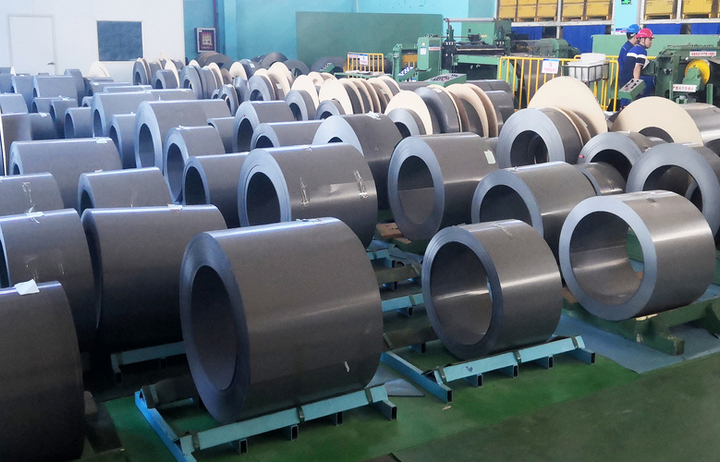
Transformer cores consist of thin, soft, specially alloyed electrical steel sheets. For manufacturing, they are supplied as narrow slotted strips, often without a carrier coil. This material does not tolerate rough handling. If a strip is set down on its outer surface, it can become deformed or damaged on the surface. Both of these issues will later affect the quality of the core.
Added to this is the vast variety of options. The width, diameter, and weight of the laminated strips vary with each core type. Several different strips may be stored side by side in a single storage compartment. The storage system must identify each individual strip, reliably separate them, and deliver them to the correct production line at the right time.
The more variants and production lines there are, the more difficult it becomes to reliably achieve this with manual handling—and the more production output depends on logistics.
A warehouse for transformer core raw materials must do much more than simply provide space-saving storage for heavy slit strips. The primary focus is on material protection: The strips are picked up by the coil eye and moved across gentle contact surfaces without putting strain on the sensitive outer coating. At the same time, the system must be able to handle a wide variety of configurations. Different strip widths, inner and outer diameters, and weights can be handled flexibly. Efficiency can be further increased through targeted bundling and the joint storage of strips of the same width.
Software-supported load management distributes the strips to the appropriate cantilever arms based on their geometry and weight. Cycle reliability is also crucial for a smooth production process: The required material must be available at the cutting lines in the correct order and at the right time. Unambiguous identification and weight recording of each strip ensure traceability across the individual process steps.
Every transformer core plant is different: different core types, different production lines, different facilities. That’s why every project begins with an analysis of the processes and requirements—from load profiles and material flows to cycle times, transfer points, and the desired level of automation.
This results in a plant concept that integrates technical, economic, and operational requirements. Using visualization software and digital twins, future operations can be simulated even before construction begins. This is followed by engineering, structural analysis, design, and manufacturing, then on-site installation, commissioning, and process optimization. Once the project is complete, Vollert supports the facility with service, maintenance, and modernization.
This applies to new plants as well as to expansions. Building parameters such as floor load, column grids, and ceiling heights are incorporated into the planning from the very beginning. The twin plant in Tianjin demonstrates how a concept can be adapted to a second, larger phase of expansion.
Anyone planning or expanding transformer core production must view the material flow as a continuous process chain. Every handoff between warehousing, transportation, and production affects efficiency and carries the risk of lost time or damage to materials.
The process begins with the receipt of slit strips and coils. The material is identified and weighed; a putaway order is then created and sent to the storage and retrieval machine. In the automated high-bay warehouse, the coils and slit strips are stored on cantilever arms. Storage locations are assigned by the higher-level warehouse control system (Level 2), taking into account the weight and geometry of the material.
When production requires specific strips, a shuttle conveyor distributes them to the respective cutting line. An upstream production buffer ensures that the strips are available in time with the line’s cycle and in the correct sequence. The production control system (Level 3) determines which materials are needed and when. At the cutting line, the strips are finally processed into core plates. This processing step is not included in Vollert’s scope of services.
Heavy-duty intralogistics projects are always unique. Different loads, material properties, production processes, and space constraints require customized solutions. Consequently, numerous challenges arise even in the early stages of a project. Below, our experts answer the most common practical questions about transformer logistics systems—based on decades of experience with automated solutions for a wide range of industries.
Who plans and implements the intralogistics for transformer core manufacturing? Who plans and implements the intralogistics for transformer core manufacturing?
Vollert plans and implements customized warehousing and material flow systems for transformer core manufacturing as a general contractor—from the initial process analysis through concept development, engineering, and installation to commissioning and subsequent service. In doing so, warehousing technology, conveyor technology, and control systems are optimally tailored to the specific requirements of transformer production. One example is the two expansion phases of a transformer core plant in Tianjin, China. There, automated cantilever high-bay warehouses and shuttle platforms ensure the efficient storage and targeted supply of transformer core material to the cutting lines.
What requirements must a warehouse for split strips in transformer core manufacturing meet? What requirements must a warehouse for split strips in transformer core manufacturing meet?
A warehouse for slit strips must handle delicate, thin material with particular care. The material is picked up directly at the coil eye, without a carrier spool and without applying pressure to the outer casing. At the same time, the system must flexibly manage different strip widths, inner and outer diameters, and weights, and load the cantilever arms according to the actual loads. It is also crucial to supply the cutting lines as needed and in the correct order. End-to-end traceability, reliable weight measurement, and a well-designed redundancy concept ensure transparency and delivery capability—even in the event of individual component failures.
When is an automated high-bay warehouse a good investment for slit strips? When is an automated high-bay warehouse a good investment for slit strips?
An automated cantilever high-bay warehouse is particularly useful when a wide variety of slit strip variants need to be stored, multiple cutting lines need to be supplied, and existing space must be utilized optimally. Automatic storage and retrieval enable structured inventory management and on-demand material provision. Conversely, for a small number of variants, low access frequency, or manageable material flows, a manual or semi-automated warehouse may suffice. During the concept phase, Vollert determines which solution is best suited from both an economic and process-engineering perspective based on real material, inventory, and process data.
How are multiple cutting lines supplied from a single warehouse? How are multiple cutting lines supplied from a single warehouse?
Multiple cutting lines are supplied through a coordinated interaction between an automated warehouse, stacker cranes, and transfer tables. The stacker cranes retrieve the required slit strips and transfer them to the transfer tables, which transport them to the respective cutting lines. Production buffers located upstream of the lines compensate for varying cycle times and support a continuous flow of material. The higher-level production control system coordinates material allocation and determines which strip is delivered to which line at what time. This allows material supply, warehouse management, and manufacturing processes to be efficiently coordinated.