Container
logistics systems
logistics systems

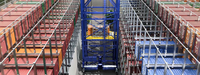
Storing containers, swap bodies, and loading units efficiently, in a space-saving manner, and fully automatically is becoming a decisive competitive factor for an increasing number of industries. In addition to container terminals at seaports, intermodal rail terminals, and air cargo hubs, CEP service providers, logistics companies, freight forwarders, and civil protection and disaster management organizations are now also facing the challenge of safely and economically handling increasing volumes within limited spaces.
Traditional storage and handling concepts using reach stackers, telescopic forklifts, or gantry cranes are increasingly reaching their limits. Direct stacking of containers and swap bodies requires a large amount of space, results in long travel distances, and necessitates numerous restacking operations. The result is rising operating costs, longer access times, and declining process efficiency.
70% less space required and higher productivity
Vollert develops fully automated high-bay storage systems for freight containers and swap bodies weighing up to 40 metric tons—requiring up to 70% less space and eliminating unproductive relocation and order-picking processes.
 0
less storage space
0
less storage space
 0
heavy containers
0
heavy containers
 0
fewer stock transfer processes
0
fewer stock transfer processes
At the heart of the Vollert container logistics system is a fully automated, multi-level high-bay storage system designed specifically to meet the requirements of container handling. Compact storage and retrieval machines handle the storage and retrieval of freight containers weighing up to 40 metric tons—quickly, precisely, and without manual intervention.
Each storage location is individually accessible. This eliminates the biggest inefficiency problem associated with traditional stacking concepts: the effort required for repositioning and order picking. At the same time, the crosswise storage of containers and swap bodies provides special protection against lateral vibrations.
State-of-the-art positioning and safety technology prevents container damage while ensuring a high level of operational safety for both people and materials. The entire system has a modular design—the stacker cranes, racking system, and control architecture can be adapted to different terminal sizes, container formats (10', 20', 40'), swap body dimensions, and throughput requirements.

Fully automated control and Industry 4.0 integration
The control architecture of the Vollert system coordinates all transport and loading processes in real time. Storing, retrieving, buffering, and transferring cargo to downstream transport vehicles are controlled fully automatically and seamlessly documented. The system is designed to integrate with existing terminal management systems, customs software, or higher-level logistics platforms.
This not only ensures process reliability but also provides the data foundation for continuous optimization of terminal operations—a decisive advantage in environments where throughput and availability have direct economic implications.
Weather protection and emissions reduction as system benefits
An often underestimated aspect: The Vollert concept enables the storage and retrieval of containers and swap bodies while protecting them from light and the elements. This is relevant not only for sensitive goods but also for customs clearance, loading and unloading operations, and the occupational safety of terminal personnel. At the same time, automation significantly reduces noise and dust emissions—an increasingly important factor in light of stricter environmental regulations in port cities and urban logistics centers.
The Vollert concept is not limited to a single type of terminal. It is relevant wherever freight containers and swap bodies need to be handled and sorted in large quantities, under time pressure, and in a limited space.

PORTS AND MARITIME CONTAINER TERMINALS
In seaports, space is structurally limited. New terminal space is scarce, and approval processes are lengthy. The Vollert system enables a significant increase in capacity within existing space—without the need for new construction projects and without interrupting operations during implementation.

INTERMODAL RAIL TRANSFER TERMINALS
In combined rail-road transport, short transshipment times are crucial. Every minute of waiting time at the terminal costs money. The fully automated high-bay storage system drastically reduces transshipment times and enables precise synchronization of the handover processes to trucks and trains.

CIVIL PROTECTION, DISASTER MANAGEMENT, AND DEFENSE
In civil protection, disaster relief, and defense, automated high-bay warehouse systems ensure that containers and swap bodies filled with materials, vehicle equipment, or supplies are always available and securely stored. Automated provision shortens response times and supports fast, reliable operational logistics—even with large inventories of materials.

EXPRESS, COURIER, AND PARCEL SERVICES, LOGISTICS COMPANIES, AND FREIGHT FORWARDERS
Automated high-bay warehouse systems ensure a continuous flow of materials between delivery, temporary storage, and the loading of containers and swap bodies. Thanks to short access times, high storage density, and intelligent control, handling processes are accelerated, operating costs are reduced, and space efficiency is significantly increased.
The global volume of container and swap body transport is growing steadily. At the same time, demands for cost-effectiveness, automation, sustainability, and space efficiency are increasing. Whether it’s a container terminal, a package and distribution center, a logistics hub, or a secure material storage facility—in many locations, additional space is no longer available or can only be developed with significant construction and permitting efforts.
Conventional handling and order-picking technology is designed for horizontal storage areas. Containers and swap bodies are placed side by side on the floor or stacked on top of one another, meaning that each access requires multiple repositioning maneuvers. This leads to unnecessary vehicle movements, increased energy consumption, machine wear, and longer turnaround times.
Vollert therefore takes a fundamentally different approach: Instead of expanding storage areas horizontally, containers and swap bodies are stored vertically in fully automated high-bay warehouse systems. Intelligent storage and retrieval machines handle all storage and transport movements, while the overarching control software coordinates all material flows in real time. The result is significantly higher storage capacity, reproducible processes, and cost-effective operation—regardless of whether the system is used in a port, a rail terminal, a logistics center, a CEP hub, or a security-critical supply location.
The decision to implement an automated container logistics system is not merely a technological issue. It is a strategic investment decision that must be evaluated based on specific operational metrics.
The Vollert concept addresses the three key cost drivers in container handling: space consumption, re-stacking and picking effort, and throughput time. Vertical densification of the warehouse reduces space requirements by up to 70%—without compromising storage capacity. On the contrary: capacity increases because the available vertical space—which remains unused in traditional stacking concepts—is utilized.
Unproductive relocation or picking processes are eliminated entirely because every container is directly accessible. This shortens turnaround times, reduces machine hours, and lowers wear and tear on handling equipment. The result is an operational model that is not only more efficient but also more scalable—because the system’s modular design allows for gradual expansion without interrupting ongoing operations.