Bridge girder cranes
for heavy load transports
for heavy load transports


Single-girder or double-girder bridge cranes: Vollert develops bridge girder crane systems for the reliable transport of heavy and large-format workpieces under the most demanding operating conditions.
Sophisticated heavy-duty system solutions
When loads weighing several metric tons need to be moved off the floor, precisely, and around the clock, standard crane solutions quickly reach their limits. Vollert’s bridge crane systems are not off-the-shelf products—they are developed as well-thought-out system solutions based on load profiles, process logic, building layout, and operational requirements—always featuring a four-rope hoist and grippers and crossbeams tailored to specific needs
Whether in the steel industry, aluminum plants, the wood industry, or heavy machinery manufacturing: Vollert plans, designs, and implements single-girder and double-girder bridge crane systems that operate reliably and remain available even under extreme conditions—heat, cold, dust, and dirt—over the long term. The focus is not on the crane bridge alone, but on the entire material flow in which the system is embedded.
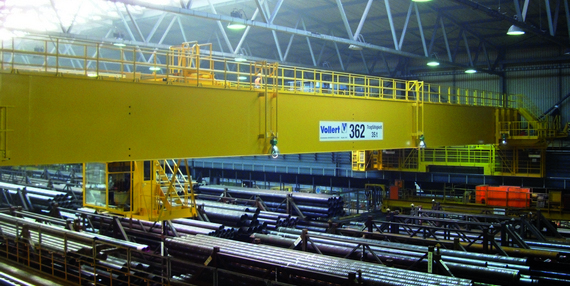
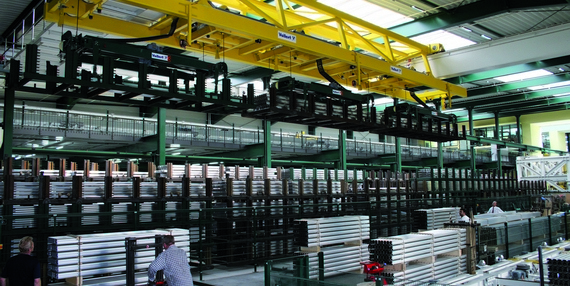
Bridge-girder crane systems are the preferred solution in heavy-duty intralogistics when large and heavy workpieces need to be moved off the floor, close to the production process, and with high repeatability.
What distinguishes these systems from simple overhead cranes is not their basic design, but the level of complexity required. In industrial production environments, girder cranes are often used in fully or partially automated operation—24 hours a day, seven days a week—under conditions for which standard components are not designed.
High temperatures, harsh production environments, or tight cycle times: Anyone planning to use a standard crane that is to be retrofitted for automation risks availability issues, unplanned downtime, and high follow-up costs. Vollert develops gantry crane systems that are designed from the outset to handle these operational realities—in terms of design, control technology, maintainability, and system integration.
Bridge-girder crane systems are rarely operated in isolation. In practice, they are part of a larger material flow—integrated into production lines, buffer systems, storage areas, or automated material handling systems. It is precisely this system integration that sets an engineering partner apart from a mere crane supplier. We can supply the other critical material-handling components from a single source.
Vollert always considers the girder crane system within the context of the overall process: What materials are coming from where, where do they need to go, at what cycle rate, with what positioning accuracy, and with what interfaces to adjacent systems? Only through this process analysis can a crane architecture be developed that not only functions technically but also delivers consistent performance in real-world operation.
This also applies to brownfield projects: When existing crane runways, support structures, or control systems are to be reused or modernized, Vollert brings the expertise to integrate new systems into existing infrastructure—without unnecessarily disrupting ongoing operations.
Heavy-duty intralogistics projects are always unique. Different loads, material properties, production processes, and space constraints require customized solutions. Consequently, numerous challenges arise even in the early stages of a project. Below, our experts answer the most common practical questions about heavy-duty girder cranes—based on decades of experience with automated solutions for a wide range of industries.
What load capacities can be achieved with Vollert bridge girder crane systems? What load capacities can be achieved with Vollert bridge girder crane systems?
Vollert develops bridge crane systems for load capacities ranging from approximately 2 to 50 metric tons, and even beyond that in special applications. However, load capacity alone is not the sole determining factor in the design. The load profile, span, lifting height, duty cycle, cycle rate, and the desired service life of the system are also taken into account. Environmental conditions and the degree of automation are also factored into the planning. Based on these considerations, a custom-designed crane system is created that is optimally tailored to the material flow and the respective production processes and ensures a high level of operational reliability over the long term.
Can bridge-type cranes also be retrofitted into existing warehouses? Can bridge-type cranes also be retrofitted into existing warehouses?
Yes. Vollert has extensive experience in modernizing and retrofitting bridge crane systems in existing production and warehouse facilities. As part of a site analysis, existing support structures, crane runways, facility geometries, and existing control and automation systems are examined in detail. Where technically and economically feasible, existing components can be reused or specifically upgraded. This reduces investment costs and minimizes disruption to ongoing operations. The result is a high-performance solution that integrates seamlessly into the existing infrastructure.
What sets Vollert apart from traditional crane manufacturers? What sets Vollert apart from traditional crane manufacturers?
Vollert develops bridge crane systems not as standalone machines, but as an integral part of a comprehensive heavy-duty intralogistics solution. In addition to crane technology, material flow, load-handling attachments, conveyor technology, control systems, automation, and integration with WMS, MES, or ERP systems are all considered together from the very beginning. This results in customized, comprehensive solutions that are precisely tailored to the respective production processes. Particularly in cases involving complex material flows, high availability requirements, and demanding industrial environments, this systematic engineering approach offers decisive advantages over standardized crane solutions.
How is availability ensured during continuous operation? How is availability ensured during continuous operation?
High plant availability is taken into account as early as the design phase and is an integral part of the system design. This includes redundant drive concepts for critical functions, maintenance-friendly designs, modern diagnostic and condition monitoring systems, as well as remote maintenance and service functions. This is complemented by a proactive spare parts strategy and customized service and maintenance concepts. The goal is to avoid unplanned downtime, reduce maintenance times, and ensure reliable long-term operation even during multi-shift or 24/7 operation.
At what point does fully automatic operation become worthwhile? At what point does fully automatic operation become worthwhile?
Whether fully automated operation is economically viable depends on numerous factors. These include cycle times, production volume, shift schedules, labor costs, safety requirements, and the desired process stability. As part of the project analysis, Vollert evaluates these parameters together with the customer and develops a well-founded economic feasibility assessment. In addition to investment costs, potential savings, productivity gains, and long-term operating costs are also taken into account. This provides a solid basis for deciding on the appropriate level of automation for the crane system.