Portal/semi-gantry cranes
for heavy load transports
for heavy load transports

When bridge girder cranes reach their structural limits: Vollert’s gantry and semi-gantry crane systems enable precise heavy-load handling without a hall structure—floor-guided and integrated into the production process, with a load capacity ranging from 2 to 50 metric tons.
Crane systems tailored to the application
Not every production or logistics environment allows for the use of conventional bridge crane systems. Where no suitable building structure is available, gantry and semi-gantry crane systems offer a technically superior alternative. They move autonomously on floor-mounted guide rails, thereby providing freedom of movement in the third dimension—regardless of the building’s structure.
Vollert develops and implements gantry and semi-gantry crane systems as integrated process solutions: tailored to load profiles, cycle time requirements, environmental conditions, and interfaces with adjacent production or logistics processes.
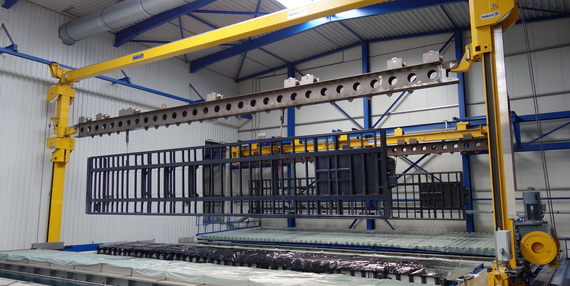
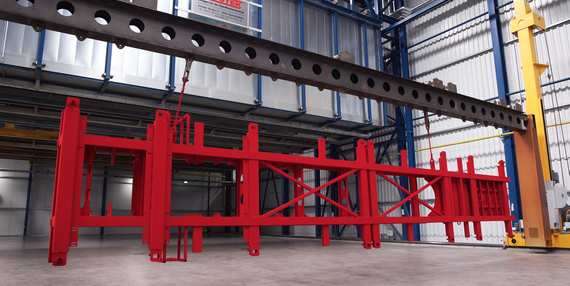
In a gantry crane, both sides of the crane run on tracks laid in the floor. The system is completely independent of the building structure and is therefore particularly well-suited for open storage areas, outdoor facilities, or warehouses where no usable supporting structure is available. The track width, lifting height, and load capacity are designed on a project-by-project basis—ranging from compact systems for workpiece handling to large gantries for heavy-duty material handling.
The semi-gantry crane combines a floor-guided side with a guide side that is attached to an existing steel structure—such as a warehouse wall, a support structure, or an existing crane runway profile. This design is particularly cost-effective when a suitable connection structure is already in place. At the same time, the floor-running side remains freely accessible, allowing for unrestricted loading and unloading operations with vehicles or industrial trucks.
Automation and control integration
Both systems can be operated fully automatically. Vollert integrates gantry and semi-gantry cranes into higher-level control architectures—ranging from simple PLC solutions to fully networked material flow computers with interfaces to WMS, MES, or production control systems. Positioning accuracy, collision protection, diagnostic capabilities, and remote maintenance access are not optional features but integral parts of the system design.
The strengths of portal and semi-portal crane systems are particularly evident in applications that combine heavy loads, demanding process environments, and specific accessibility requirements. Three areas of application are of particular importance here.

LOADING AND UNLOADING OF HEAVY-DUTY CARGO
As a loading and unloading crane, the semi-gantry crane provides direct access for trucks, rail cars, or other modes of transport on the ground-level side. At the same time, the crane handles heavy cargo—from steel coils to precast concrete elements to mechanical assemblies—with high repeatability and without disrupting traffic flow. This combination of accessibility and load-bearing capacity is hardly economically feasible with other crane systems.

SURFACE TREATMENT AND COATING SYSTEMS
In dip coating, pretreatment, and coating systems, workpieces—often large-format automotive body parts, commercial vehicle components, or industrial parts—must be precisely lowered into tanks, guided through treatment zones, and removed again. Gantry crane systems not only handle the transport here but are also an active part of the process: with defined immersion depths, dwell times, motion profiles, and fully automated control. The process media place special demands on corrosion protection, sealing, and accessibility for maintenance.
Gantry and semi-gantry crane systems are not simply simplified bridge cranes. They follow their own design and operational logic, which stems from the specific requirements of their operating environments. Anyone who views these systems merely as “cranes without a building” underestimates the complexity associated with floor-mounted heavy-duty systems.
The load is not transferred via a building structure but directly into the ground. This places special demands on foundation design, rail installation, tolerances, and long-term stability—especially for loads in the range of 10, 20, or 50 metric tons. At the same time, gantry crane systems must be able to cope with outdoor weather conditions, process media such as paints or acids, tight cycle times, or fully automated control architectures in many applications.
Added to this is the issue of system integration: gantry and semi-gantry cranes are rarely stand-alone units. They are part of a larger material flow—as loading and unloading cranes, as process-handling systems in surface treatment facilities, or as automated transport hubs between production areas. It is precisely this integration into the overall process that determines the actual added value.
A gantry or semi-gantry crane system is not a catalog product. System design begins with a detailed analysis of the requirements—and this analysis plays a decisive role in determining the cost-effectiveness, availability, and operational safety of the final system.
The load parameters are the first critical factors: load capacity, center of gravity, load geometry, and handling requirements (lifting, lowering, positioning, tilting). This determines the basic design of the gantry, the configuration of the hoist, travel mechanism, and crane girder, as well as the selection of suitable load-handling attachments.
Equally important are the environmental conditions: indoor or outdoor use, process media, temperature ranges, dust exposure, or explosion protection requirements. These parameters influence material selection, surface protection, sealing concepts, and the design of the electrical and control systems.
Finally, interfaces and operational logic must be considered from the very beginning: How will the crane be integrated into the material flow? What signals are coming from the production control system? How are maintenance and inspection ensured during operation? Vollert answers these questions not just during detailed planning, but already at the concept stage—because that is precisely where the essential course is set.
Heavy-duty intralogistics projects are always unique. Different loads, material properties, production processes, and space constraints require customized solutions. Consequently, numerous challenges arise even in the early stages of a project. Below, our experts answer the most common practical questions about heavy-duty gantry cranes—based on decades of experience with automated solutions for a wide range of industries.
What is the fundamental difference between a gantry crane and a bridge crane? What is the fundamental difference between a gantry crane and a bridge crane?
The main difference lies in the design and load transfer. An overhead crane is suspended from the building structure and transfers its loads through the building’s load-bearing framework. A gantry crane, on the other hand, stands on its own supports and travels on rails laid on the floor. As a result, it operates independently of the building’s structural integrity and can be used both indoors and outdoors. Gantry cranes are particularly well-suited for applications where the building structure lacks sufficient load-bearing capacity or wherever large working areas, unobstructed access, and flexible material flows are required.
For what load capacities are Vollert's gantry and semi-gantry crane systems designed? For what load capacities are Vollert's gantry and semi-gantry crane systems designed?
Vollert develops gantry and semi-gantry crane systems for load capacities ranging from approximately 2 to 50 metric tons, and even higher in special applications. The design is always customized based on the specific requirements. Factors taken into account include load weight, workpiece geometry, handling capacity, cycle times, positioning accuracy, and operating and environmental conditions. Instead of standardized load capacity classes, we create custom crane systems that are optimally integrated into the material flow and ensure safe, economical, and precise handling even with heavy loads.
Can gantry and semi-gantry cranes be operated fully automatically? Can gantry and semi-gantry cranes be operated fully automatically?
Yes. Vollert fully integrates gantry and semi-gantry crane systems into automated material flow and production processes. The cranes are equipped with high-performance control systems and connected to higher-level warehouse management, production, or control systems. Features such as high-precision positioning, automatic travel and lifting movements, collision protection, condition monitoring, remote diagnostics, and remote maintenance are integral components of the system architecture from the outset. This results in high-performance automated crane systems with high process reliability, reproducible operations, and maximum system availability.
What should be considered when planning foundations for gantry crane systems? What should be considered when planning foundations for gantry crane systems?
Since all loads from a gantry crane are transferred to the ground via the running gear, foundation and rail design are of particular importance. As early as the conceptual phase, Vollert analyzes the ground bearing capacity, the settlement behavior of the subsoil, permissible tolerances, and the long-term stability of the track. In addition, dynamic loads resulting from acceleration and braking maneuvers are taken into account. Through close coordination with construction planning and structural engineering, this ensures a permanently safe and precise infrastructure for the reliable operation of the crane system.
How does Vollert differ from traditional crane manufacturers? How does Vollert differ from traditional crane manufacturers?
While traditional crane manufacturers primarily offer standardized cranes with limited customization options, Vollert develops gantry and semi-gantry crane systems as part of a comprehensive intralogistics solution. Load-handling attachments such as crossbeams, grabs, or special tools are designed just as individually as the conveyor technology, control systems, and automation. The goal is not only to lift and transport heavy loads, but also to ensure optimal integration into the overall material flow. This results in high-performance integrated systems with high process reliability, short cycle times, and long-term cost-effective plant performance.