


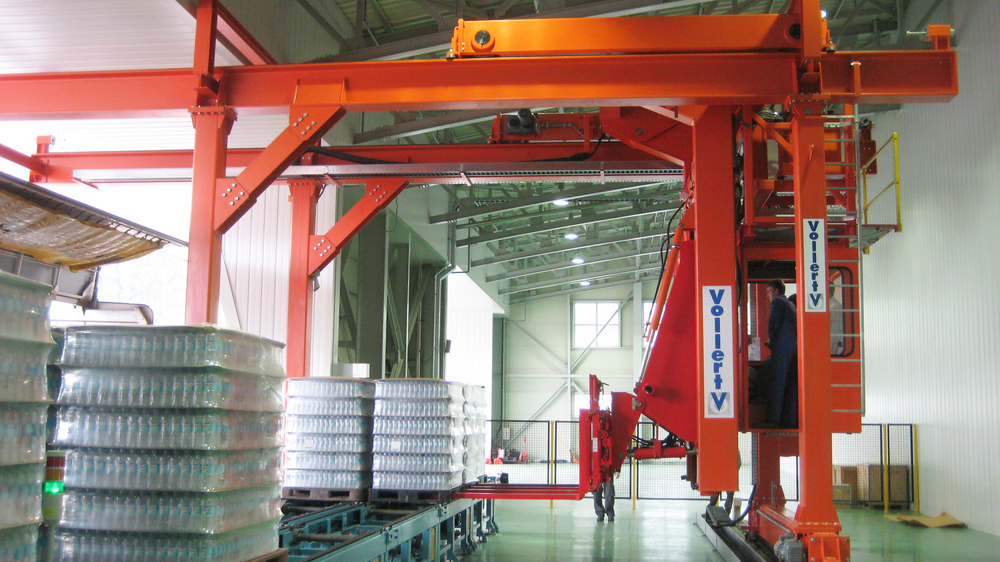
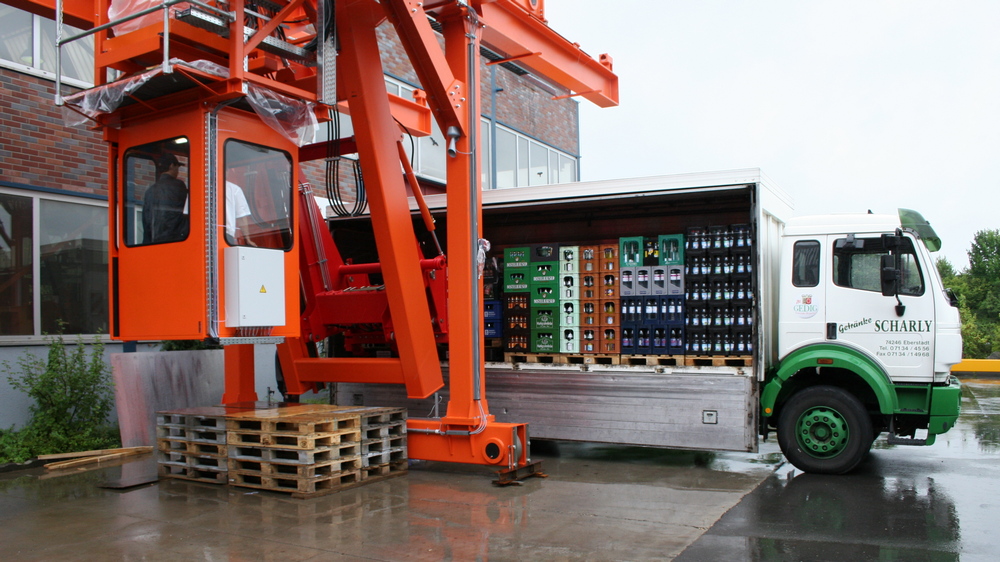

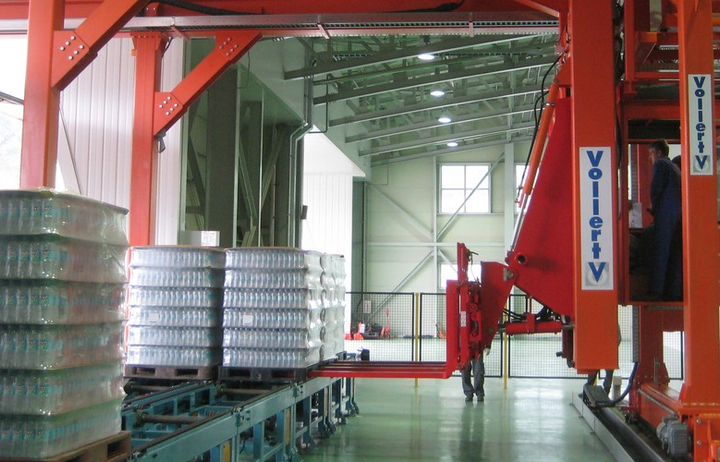
Facility for loading 10,000 beverage crates per hour


Crane systems are used in virtually every industry. But as soon as loads, geometries, cycle time requirements, or environmental conditions deviate from the norm, standard solutions quickly reach their limits. That’s exactly where Vollert’s work begins: with crane systems that aren’t taken straight from a catalog, but are developed based on a deep understanding of the specific process.
Whether it’s high-throughput truck loading, stacking cranes for automated warehouse systems, or special hoisting equipment for sensitive or oversized loads—what matters isn’t the crane system itself, but how it’s integrated into the overall process. Vollert designs, simulates, and implements specialized industrial cranes as an integral part of the production and logistics architecture.
Specialized industrial cranes are found in nearly every industrial sector. What they have in common is not the industry itself, but the requirement: a process that cannot be carried out economically or safely using standard equipment.

LOADING AND LOGISTICS WITH HIGH THROUGHPUT
In the beverage, food, and consumer goods industries, loading processes are often time-sensitive and high-volume. Here, crane systems must not only lift, but also grip, position, and transfer loads with precision—at a high cycle rate and with minimal staff. The Login Beverage reference project demonstrates how a specially developed crane system can load 10,000 beverage crates per hour onto trucks.

AUTOMATED WAREHOUSE SYSTEMS AND STACKING CRANES
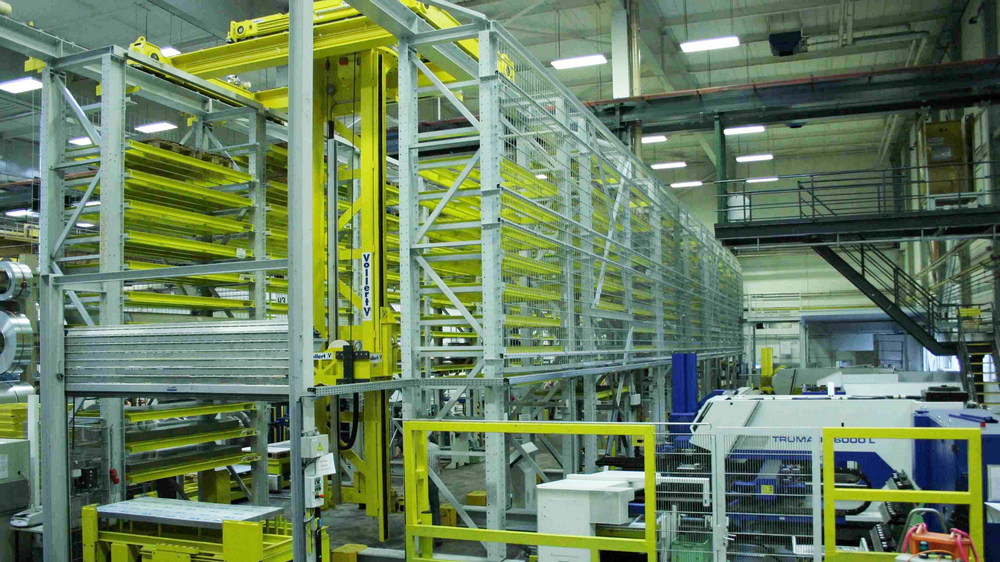
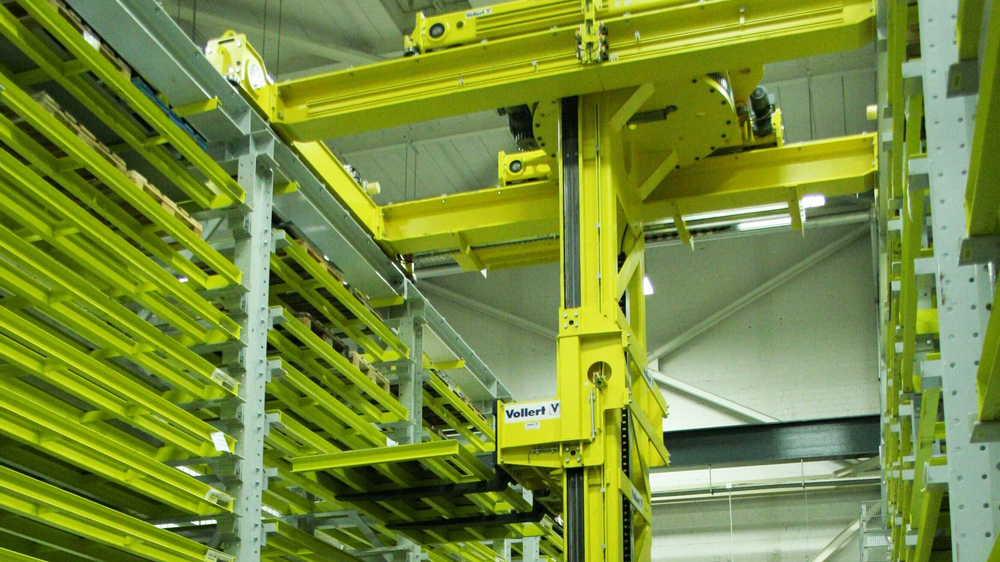
In automated high-bay warehouses or buffer systems, stacking cranes perform the function of a storage and retrieval machine—with the difference that they are designed for significantly heavier loads, larger dimensions, or specific gripping requirements. Vollert develops these systems as an integral part of the warehouse architecture, not as an afterthought.

PROCESS-INTEGRATED CRANES IN PRODUCTION
Wherever components must not only be transported but also integrated into production steps—such as when loading them into presses, turning workpieces, or feeding them into machining centers—special-purpose process-integrated cranes are required. They must communicate with the machine control system, move precisely to specific positions, and adhere to cycle times.

SPECIAL LOAD-HANDLING DEVICES FOR CRITICAL GOODS
Delicate, oversized, or geometrically complex loads require custom-designed load-handling equipment. Vollert develops spreaders, grippers, suction frames, and lifting tools that are tailored to the specific cargo—thereby preventing damage, process interruptions, and safety risks.
Standard cranes are designed for recurring, well-defined load patterns. However, as soon as industry requirements, process logic, or load geometries deviate from these standard conditions, gaps emerge—in precision, availability, process integration, or cost-effectiveness.
Specialized, fully automated industrial cranes are not niche products. They are the logical solution to requirements that frequently arise in practice but can rarely be met with standard equipment: loads that are not symmetrical; processes that require high cycle rates; Environments where temperature, humidity, dust, or explosion protection impose special design requirements. Or material flows in which the crane and production line must communicate closely with one another.
Vollert develops these systems not as isolated lifting devices, but as an integral part of a well-thought-out process architecture. This begins as early as the planning phase with the simulation of transport routes, cycle times, and boundary conditions—and culminates in a system that operates reliably in real-world conditions.
A specialized industrial crane is only as good as the planning that goes into it. Vollert begins every project with a structured analysis of the process requirements: What loads will be moved? At what cycle rate? Under what environmental conditions? What interfaces exist with production, warehousing, or IT?
Based on this, transport routes, lifting heights, positioning accuracies, and load-handling attachments are simulated as early as the planning phase. This allows bottlenecks, collision risks, and design errors to be identified before the first component is built. This reduces planning risks, shortens commissioning times, and increases operational reliability.
Vollert handles not only the mechanical design but also the control technology, the safety architecture, and integration into higher-level systems. The result is not a single device but a fully functional complete system.