Process cranes for the
construction material industry
construction material industry

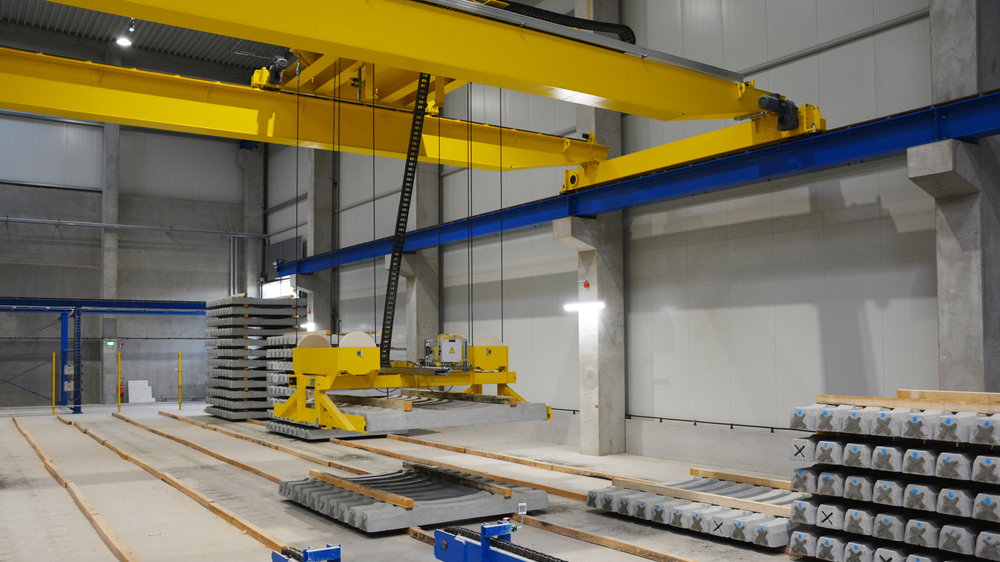
Precast concrete elements, aerated concrete blocks, facade panels, concrete products, or fiber-cement panels: In the building materials industry, the demands placed on crane systems are exceptionally high. Dust, moisture, aggressive material particles, and high cycle rates place constant strain on the equipment. At the same time, loads weighing several metric tons must be moved with precision, repeatability, and process reliability—often fully automatically, around the clock.
100% custom-engineered
Vollert develops and manufactures process cranes that are specifically designed for these conditions. Not as a standard product, but as an engineered solution that integrates load profiles, material characteristics, production logic, and environmental conditions from the very beginning. Leading manufacturers worldwide in the precast concrete and aerated concrete industries rely on this expertise.
The requirements for automated crane systems in the building materials industry vary considerably depending on the sector and production process. Vollert serves two distinct application areas, each with its own specific system requirements.

PRECAST CONCRETE AND AERATED CONCRETE PRODUCTION
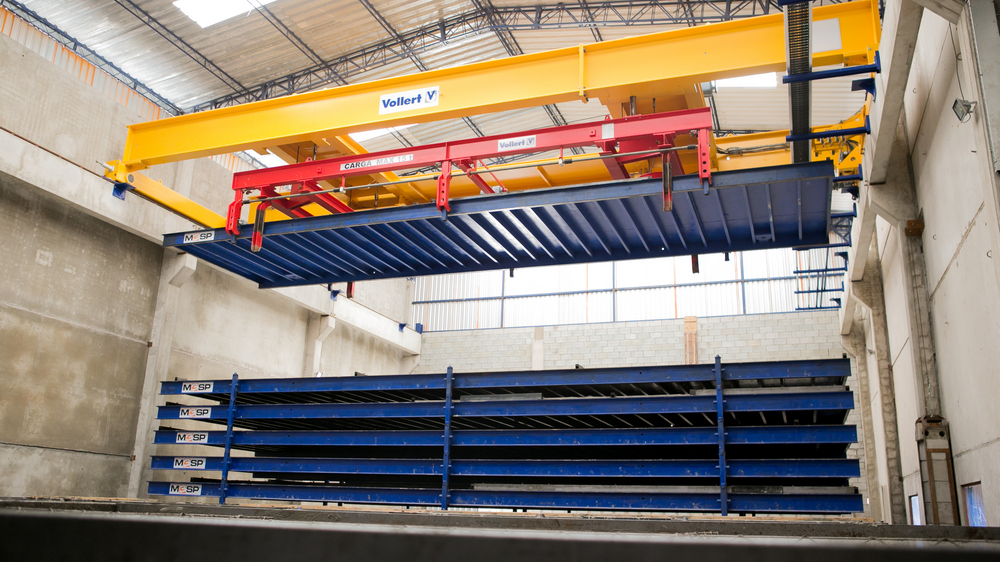
In concrete plants and aerated concrete production facilities, process cranes are the backbone of material logistics. They handle fresh and cured concrete elements, stack and store precast components, and load and unload curing chambers. This is particularly critical: Fresh concrete elements are mechanically sensitive and must not be deformed or damaged. This requires precise load-handling attachments, smooth travel movements, and precisely tuned control logic.

FIBER CEMENT AND SPECIALTY BUILDING MATERIALS
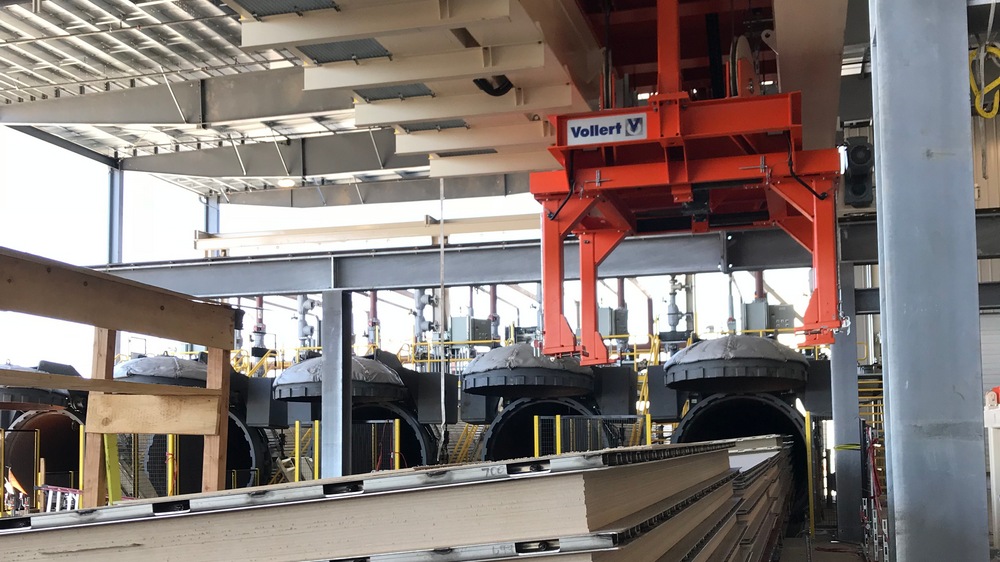
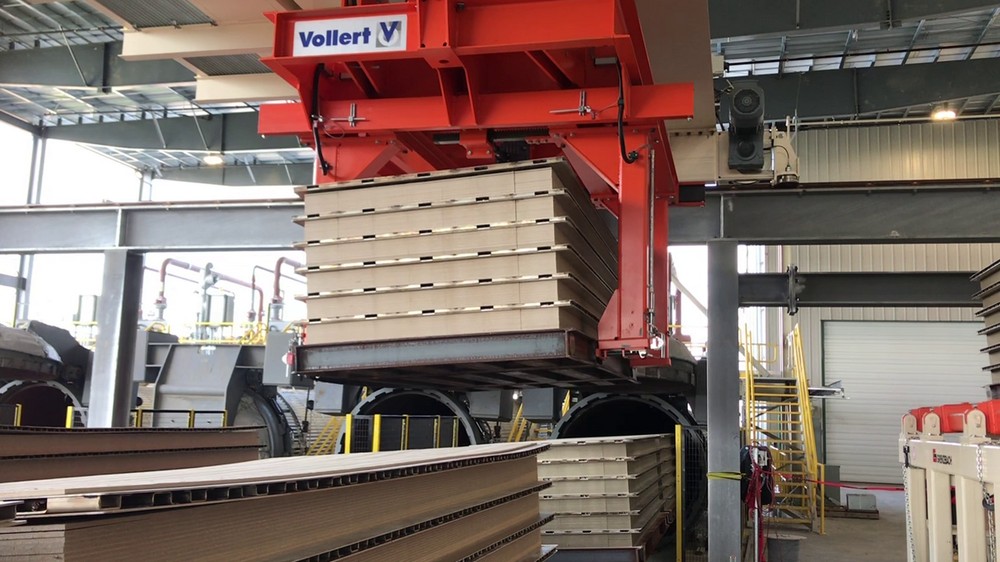
Vollert process cranes are also used in the manufacture of fiber cement panels, roof tiles, and other specialty building materials. Here, the focus is often on the careful handling of delicate stacks of panels, the automation of loading and unloading processes, and integration into fully automated production lines. References such as James Hardie demonstrate the practical suitability of these solutions on an international scale.
Crane systems in the building materials industry are not exposed to a typical industrial environment. Cement dust, cement slurry, moisture from hardening processes, and extremely fine mineral particles place mechanical, electronic, and sensor components under constant strain. What works flawlessly in a clean production hall will fail here after a short time—unless the design is tailored to these conditions from the outset.
Added to this is the proximity to the production process: In concrete plants or aerated concrete production facilities, cranes are not merely means of transport. They are an integral part of the production process—for placing reinforcement, clamping or separating rows of blocks, stacking and storing precast elements, or feeding curing chambers. Errors or failures have a direct impact on the entire production cycle.
Standard cranes from general crane manufacturing are not designed for this combination of environmental stresses, process integration, and availability requirements. Vollert has therefore developed a specialized crane portfolio based on decades of project experience in precisely these industries.
A process crane for the building materials industry is not a catalog product. It is developed based on an analysis of the specific application: What loads will be moved? What does the load-handling device look like? What are the environmental conditions? How is the crane integrated into the production control system?
Vollert views these questions as part of a cohesive system design. This begins with the support structure and trolley, continues through the selection of appropriate protection classes for drives and sensors, and extends to the design of the load-handling attachments. In the building materials industry, the load-handling attachment is often the most technically challenging component. Whether it’s a vacuum beam for concrete slabs, a gripping tong for aerated concrete blocks, a spreader for fiber-cement stacks, or a special beam for construction machinery components: The design must simultaneously account for load geometry, surface conditions, material sensitivity, and process requirements.
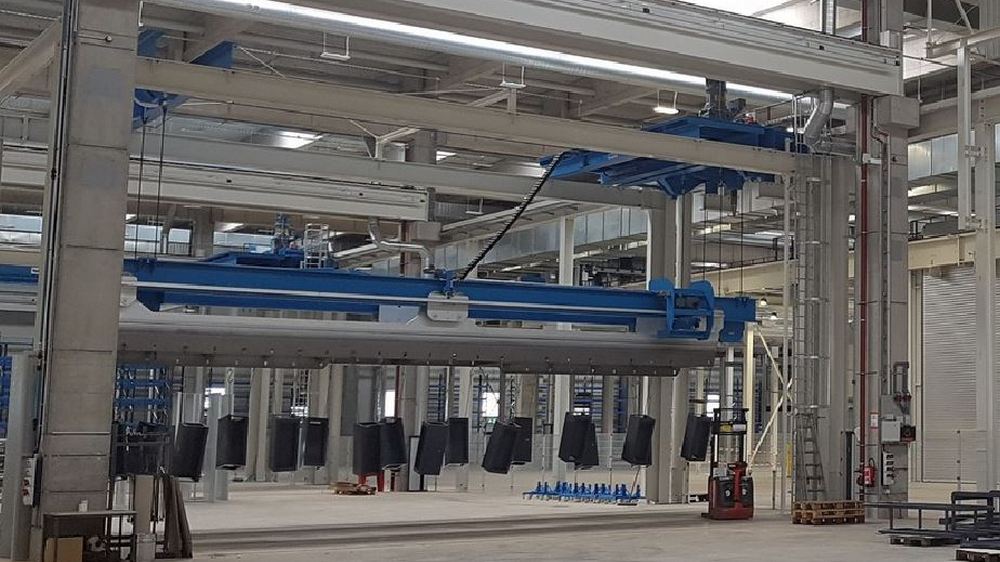
Fully automated process cranes in the building materials industry are typically integrated into higher-level production or warehouse management systems. The control architecture must not only precisely control travel movements but also manage collision protection, load monitoring, diagnostic data, and interfaces to MES or WMS systems. Vollert develops these control solutions in-house, ensuring that the mechanics, drive system, and controls function as a coordinated system.