Second transformer plant with fully automated cantilever storage system for steel coils in China


Heavy-duty cantilever racking from Vollert is designed for numerous applications – wherever long, bulky, and particularly heavy goods need to be stored safely. Whether slit coils, wire bundles, or other oversized workpieces: Vollert designs cantilever storage systems for industrial heavy-duty applications where standard solutions reach their structural and static limits. Our systems are designed for actual load conditions—featuring stacker cranes that are among the most powerful in their class and system logic that can be integrated into existing production and logistics processes.
The advantage of a cantilever rack system is that existing storage locations can be used flexibly and can be reallocated in the warehouse management system depending on the size of the stored goods.
As soon as workpieces are long, asymmetrical, or difficult to handle, traditional storage systems quickly reach their limits. Cantilever racking was developed specifically to meet these requirements. Thanks to its open design, it is particularly well-suited for long materials, profiles, pipes, beams, or large-format components. Cantilever racking is also an attractive and cost-effective alternative to traditional high-bay racking in coil storage applications.
In heavy-duty applications, however, additional technical requirements arise. The load not only acts vertically but also generates additional lever forces on the structure. The real challenge, therefore, lies less in the rack itself than in its interaction with the material-handling equipment. Process cranes or automated gripping systems ensure the safe handling of workpieces and enable even large and heavy components to be stored efficiently.
Automation is generally possible here, though it depends heavily on the standardization of the workpieces. If dimensions, weights, and material properties vary significantly, the technical complexity increases considerably. At the same time, the demands on sensor technology, positioning, and control systems also rise.
Cantilever racking is structurally more complex than traditional pallet racking. The cantilever arms generate significant moments on the uprights, crossbeams, and foundations due to bending and lever forces. The heavier and longer the stored goods, the higher the static and dynamic demands on the entire system. Anyone who underestimates these factors risks deformation, instability, or—in the worst case—the failure of the entire storage structure. Calculating the steel structure is significantly more complex. With its own in-house structural engineers, Vollert is able to develop solutions that are significantly slimmer and lighter than standard solutions.
Added to this are the realities of operation: Long workpieces such as slit strips, coils, pipes, or even wood-based materials require sufficient maneuvering space, suitable holding devices, and a conveyor system that transports the material safely and reliably. Uneven loading of individual arms, lack of load securing, or an inadequate loading concept are typical weak points that must be consistently addressed during the planning phase. Attention must also be paid to the deflection of the stored goods.
Many cantilever racking systems are still operated manually or with conventional cranes today. This works in small warehouses with manageable access frequencies—but quickly reaches its limits when cycle times increase, labor costs rise, or sources of error in manual operation lead to production interruptions.
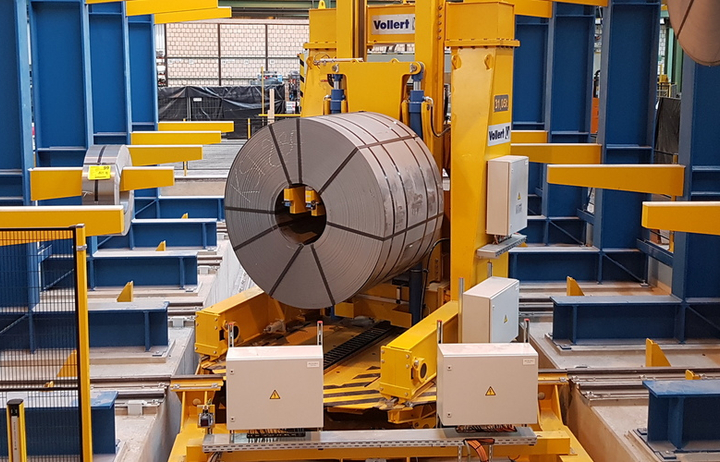
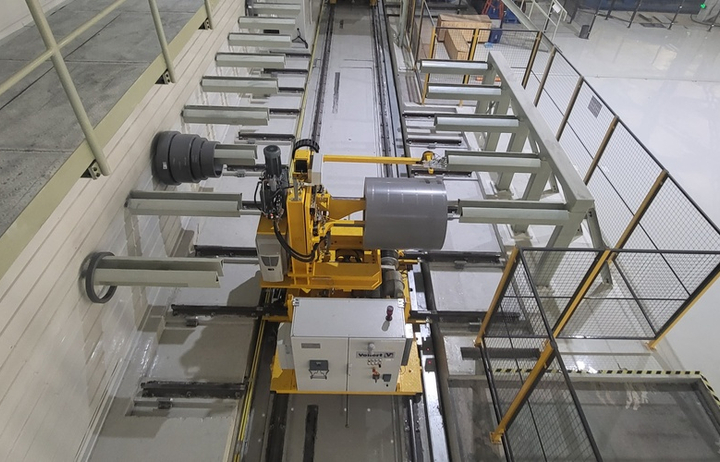
Vollert implements automated cantilever warehouses with high-performance heavy-duty storage and retrieval machines that store and retrieve loads precisely, reproducibly, and without manual intervention. The rack feeders are designed to meet the specific requirements of the respective stored goods—with suitable load-handling attachments, defined positioning accuracies, and a control system that can be integrated into higher-level warehouse management and production control systems.
The transition from manual to automated operation does not necessarily require a new facility. In many projects, existing cantilever racking structures can be upgraded to a significantly higher level of automation through targeted modernization—including new rack feeders, updated control technology, and adapted conveyor systems. Vollert supports this process from the analysis of the current situation through to the commissioning of the modernized system.
Vollert’s heavy-duty cantilever storage systems are used in a wide variety of industries and applications. What they all have in common is that the requirements for load capacity, precision, availability, and process integration far exceed what standard systems can deliver.

SLIT STRIPS AND COILS
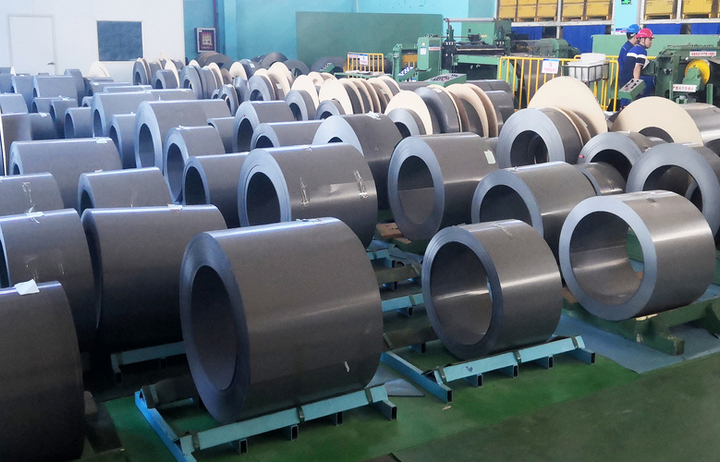
Slitted strips and coils are among the most challenging goods to store: they have high individual weights, sensitive surfaces, and material characteristics that require specific handling devices and precise positioning. Vollert cantilever racks for coil applications are designed to meet these requirements—with rack-feeding devices that safely pick up, transport, and precisely store loads. Silicon steel sheets used in transformer manufacturing, in particular, must be handled and stored with extreme care.

WIRE BUNDLES AND RING MATERIAL
Wire bundles have similar requirements to coils but often require different handling and securing solutions. In addition to load-bearing capacity, the access logic is also crucial here: Which bundle is needed when, and how can the material flow be integrated into the downstream production process?

LONG MATERIALS, PROFILES, AND PIPES
Bars, profiles, pipes, and similar long items require cantilever racks with sufficient arm depth, defined support spacing, and a conveyor system that picks up and delivers the material without damage. Especially with long workpieces, the coordination between rack geometry, rack servicing equipment, and transfer stations is crucial for smooth operation.
Heavy-duty intralogistics projects are always unique. Different loads, material properties, production processes, and space constraints require customized solutions. Consequently, numerous challenges arise even in the early stages of a project. Below, our experts answer the most common practical questions about heavy-duty cantilever racking systems—based on decades of experience with automated solutions for a wide range of industries.
For which types of stored goods are Vollert heavy-duty cantilever racks suitable? For which types of stored goods are Vollert heavy-duty cantilever racks suitable?
Vollert cantilever racks are specifically designed for long, bulky, and heavy goods that cannot be stored economically or safely in conventional racking systems. Typical stored goods include slit strips, steel and aluminum coils, wire bundles, pipes, profiles, bar stock, wood-based materials, and other irregularly shaped items with individual weights ranging from several metric tons up to 50 metric tons and beyond. The open design allows for flexible storage of a wide variety of formats. Thanks to custom-designed load-bearing devices and automated handling technology, even sensitive or particularly heavy goods can be stored safely, in a space-saving manner, and efficiently.
How does a Vollert cantilever rack differ from a standard product? How does a Vollert cantilever rack differ from a standard product?
Vollert develops cantilever storage systems not as standardized solutions with retroactive adjustments, but as custom-designed, integrated systems. Every design is based on the customer’s actual requirements, including weight, dimensions, material properties, turnover rates, and process flows. Based on this, the rack structure, storage and retrieval machine, conveyor technology, and control system are optimally coordinated. This results in a solution that is both technically and economically compelling. The result is lean and efficient steel structures with high storage density, short access times, and optimal integration into existing production and logistics processes.
Can an existing manual cantilever storage system be automated? Can an existing manual cantilever storage system be automated?
In many cases, retrofitting an existing cantilever rack system with automation makes sense from both a technical and economic standpoint. As part of a detailed analysis of the existing system, Vollert examines the existing racking structures, load-bearing capacities, material flows, and operational processes. Based on this analysis, an assessment is made of which components can be reused and which modernization measures are necessary. These include, for example, new rack-servicing machines, automated conveyor systems, modern control systems, or integration with a warehouse management system. The goal is to significantly increase the warehouse’s performance while minimizing investment costs and disruptions to ongoing operations.
What structural requirements does a heavy-duty cantilever racking system place on the floor and foundation? What structural requirements does a heavy-duty cantilever racking system place on the floor and foundation?
Heavy-duty cantilever racks generate significant forces due to high individual loads and large spans, which must be safely transferred to the ground. For this reason, soil bearing capacity, foundation design, and anchoring play a central role even in the early planning phase. In addition to static loads, dynamic loads resulting from storage and retrieval processes as well as potential vibrations are also taken into account. Vollert analyzes the existing conditions and optimally coordinates the rack structure, load distribution, and foundation design. This ensures the long-term safe and economical use of the warehouse—even under high loads and intensive operating cycles.