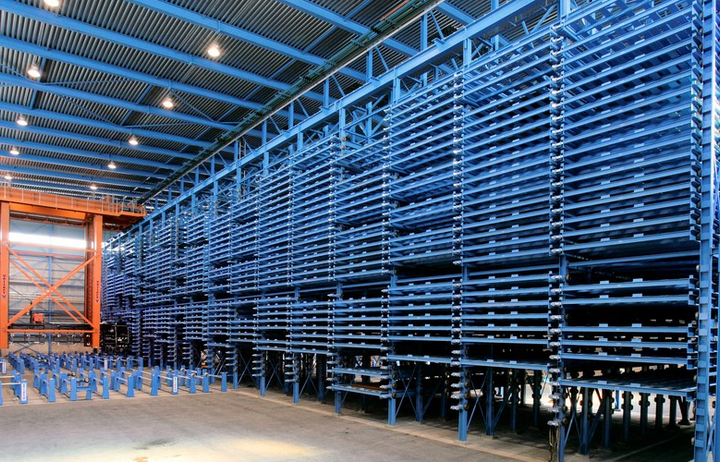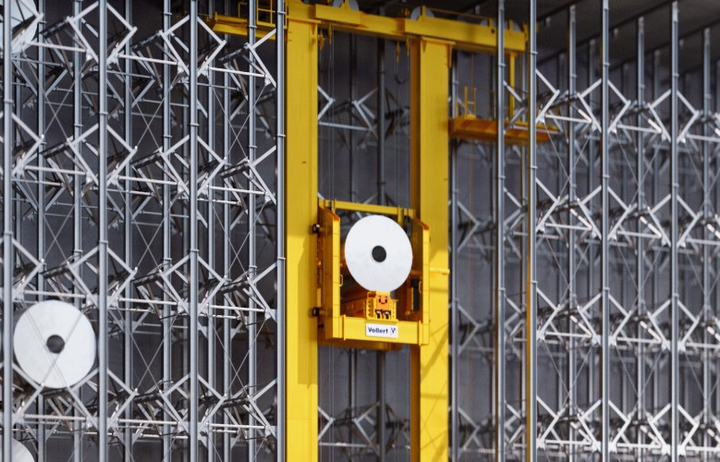
Automated intralogistics for Logan Aluminum


Vollert's heavy-duty high-bay warehouses are designed for applications ranging from 5 to 50 tons and more – wherever dimensions and weights push conventional systems to their limits. We store coils and slit strips, air freight containers, trucks, transformers, or oversized workpieces safely and efficiently. We start where others stop: with individually designed storage structures and the use of the world's most powerful heavy-duty storage and retrieval machines.
The particular challenges lie not only in the weight of the workpieces, but also in the holistic static design of the system. At the same time, our systems comply with increased safety regulations and ensure maximum process reliability, availability, and cost-effectiveness in daily operation thanks to intelligent control and monitoring concepts.
High-bay warehouses are considered the classic solution to increasing space constraints. Vertical storage offers significant advantages, particularly in production environments where warehouse space is expensive or limited. Instead of expanding the floor space further, the existing building height is utilized to create high storage capacities on a small footprint, or high-bay warehouses are attached to the building in a silo-style design.
In the heavy-duty sector, however, this concept is significantly more challenging than in traditional pallet warehouses. Nevertheless, they offer enormous potential—especially when high throughput rates must be achieved and processes are stable. Automated storage and retrieval machines handle the automated storage and retrieval of workpieces and ensure reproducible processes with high precision. Defined transfer stations allow for a close integration between the warehouse and production.
The economic advantage arises primarily when several factors come together:
High-bay warehouses for loads of 5 metric tons or more differ fundamentally from traditional warehouse systems. The challenge lies not only in the weight of the goods to be stored, but also in the combination of static, dynamic, and operational requirements that result from this. The steel structure of the warehouse itself differs fundamentally from the high-bay warehouse design of a Euro-pallet warehouse.
High bay and level loads, extreme point loads on columns and foundations, as well as dynamic forces caused by the acceleration and braking of the rack-feeding devices must be precisely calculated and incorporated into the structural design. Anyone who underestimates these interdependencies risks not only incorrect sizing but also availability issues and safety deficiencies during ongoing operations.
Added to this are the requirements for load-handling equipment: coils, slit strips, large-load carriers, satellite storage systems for multi-depth storage, transformers; rolling stands or oversized workpieces each require specific gripping, lifting, and positioning solutions that handle the material safely, with repeatable accuracy, and gently. Standard telescopic forks designed for pallets are not an option here.
Racking structure and structural analysis: The racking structure of a heavy-duty high-bay warehouse must not only support the static loads of the stored goods, but also withstand dynamic forces generated by the operation of the rack-feeding machines, wind loads in silo-style designs, and seismic requirements depending on the location. Vollert designs structural elements and foundations based on a comprehensive structural analysis—tailored to the specific load profile, the facility’s exact location, the warehouse geometry, and the operating parameters.
Heavy-duty rack-feeding devices: Vollert relies on rack-feeding devices designed for continuous operation under heavy-duty conditions. High load capacities, precise positioning even at large lift heights of up to 45 m, robust drive technology, and a maintenance-friendly design are not optional features but fundamental requirements. The units are designed specifically for each project—in terms of load capacity, lift height, travel speed, and load-handling attachments.
Load-handling attachments: Fragile or oversized goods require load-handling attachments that not only support but also protect the load. Whether coil carriers, crossbeam systems, special telescopic booms, clamping grabs with special locking mechanisms, or custom solutions for asymmetrical loads: The design of the load-handling attachments is a central component of the system architecture and is always tailored to the specific material and process context.
Vollert’s heavy-duty high-bay warehouses are used in a wide variety of industries and applications. What they all have in common is that the requirements for load capacity, precision, availability, and process integration far exceed what standard systems can deliver.

STEEL AND METAL INDUSTRY
Coils, slit strips, sheet metal packs, stacks of sheet metal, and wire bundles are among the most challenging materials to store. Heavy weights, sensitive surfaces, and tight production schedules require storage systems that operate quickly, precisely, and gently on the material. Vollert systems are in use at leading steel mills and service centers worldwide.

LOGISTICS AND PRODUCTION SUPPLY
The storage of large-scale goods—for example, in railway maintenance centers where entire bogies are stored on large-capacity load carriers—places special demands on throughput, access speed, and system availability. Even aircraft fuselage sections can be stored space-efficiently without any problems using Vollert storage and retrieval machines. Vollert implements solutions that operate reliably even in 24/7 operation.

WOOD INDUSTRY
Stacks of large-format laminate panels and the storage of OSB or MDF panels require storage systems with capacities ranging from 3 to 15 metric tons that can handle irregular dimensions, heavy weights, and varying product types. Wood-based materials are extremely sensitive to issues such as deflection. Vollert develops solutions for this—without loading aids or pallets—that combine space efficiency, gentle material handling, and flexible access.

SPECIAL CARGO AND INDUSTRIAL EQUIPMENT
Components for aircraft, railways, turbines, and generators of all kinds; complete transformers; tools; other large components; and anodes from the aluminum industry: Wherever standard storage systems are simply not designed for the task, Vollert develops customized high-bay storage solutions tailored to the specific goods, processes, and operating environment.
Heavy-duty intralogistics projects are always unique. Different loads, material properties, production processes, and space constraints require customized solutions. Consequently, numerous challenges arise even in the early stages of a project. Below, our experts answer the most common practical questions about heavy-duty high-bay warehouses—based on decades of experience with automated solutions for a wide range of industries.
For what load ranges are Vollert high-bay warehouses designed? For what load ranges are Vollert high-bay warehouses designed?
Vollert high-bay warehouses are designed for loads of approximately 5 to 50 metric tons per storage unit, and in special applications, significantly more. The specific design is always project-based and takes into account factors such as weight, dimensions, center of gravity, storage strategy, and the frequency of goods handling. Unlike standardized warehouse solutions, there is no rigid load limit. Instead, the racking structure, storage and retrieval machines, load-handling devices, and conveyor systems are coordinated as an integrated system to meet the specific requirements. This allows even particularly heavy or large-format goods to be stored safely, automatically, and in a space-saving manner.
What types of goods can be stored in Vollert high-bay warehouses? What types of goods can be stored in Vollert high-bay warehouses?
Vollert high-bay warehouses are suitable for a wide variety of heavy and demanding storage goods. These include, among other things, steel and aluminum coils, slit strips, sheet metal packs, wire bundles, wood packs, anodes, and large shelves holding a wide variety of industrial components. In addition, solutions are developed for the storage of transformers, vehicles such as trucks and buses, and particularly large or heavy components. For each type of goods, suitable load-handling equipment, racking geometries, and material flow concepts are designed. This enables both high storage densities and safe, process-optimized putaway and retrieval processes.
How does a Vollert high-bay warehouse differ from standard solutions offered by established providers? How does a Vollert high-bay warehouse differ from standard solutions offered by established providers?
Conventional high-bay warehouses are primarily designed for standardized load carriers and loads of up to about 2 metric tons. Although such systems can be adapted for heavier loads in some cases, they quickly reach their technical limits when handling heavy, bulky, or non-standardized goods. Vollert, on the other hand, develops heavy-duty high-bay warehouses specifically for demanding industrial applications. This involves adapting not only the load-bearing capacity and racking technology but also the entire system architecture. Structural design, rack servicing equipment, load-handling systems, conveyor technology, and control and automation concepts are all individually tailored to the respective material flows and process requirements. This results in high-performance, long-term cost-effective total solutions.
Can a Vollert high-bay warehouse be integrated into an existing facility? Can a Vollert high-bay warehouse be integrated into an existing facility?
Yes. Vollert implements both automated high-bay warehouses in silo-style construction and solutions within existing building and production structures. Particularly for brownfield projects, the existing conditions are analyzed in detail as early as the planning phase. This includes floor load-bearing capacity, hall geometry, column grids, fire safety requirements, and existing material flow and IT systems. The goal is to make optimal use of the available space while minimizing disruption to ongoing operations. The close integration of warehouse technology, conveyor systems, and automation results in integrated solutions that fit seamlessly into existing production and logistics processes.