


Kitchen countertops just-in-time


Wood-based materials go through numerous handling, storage, and transfer steps on their way from raw material to finished product. Whether they are cross-laminated timber elements several meters long or stacked panels—each of these materials is heavy and, at the same time, delicate. Surface damage, chipped edges, or dents can devalue entire batches. At the same time, tight production cycles and a high degree of automation require systems that operate reliably around the clock.
For over 50 years, Vollert has been developing and implementing automated crane systems for heavy-duty processes. These are not off-the-shelf standard cranes, but systems specifically designed to meet the material characteristics, process logic, and operational requirements. It is precisely this system expertise—automation, load-handling attachments that protect the material, process integration, and design for demanding environments—that can be applied to the handling and storage tasks of the wood-based materials industry.
Wood-based materials combine two characteristics that at first glance seem contradictory: they are heavy, large-format wood elements that can easily weigh several metric tons—and at the same time, they are delicate. A single scratch on a visible wood surface can significantly reduce the material’s value.
Added to this is the process logic. In industrial timber construction, crane systems are not isolated means of transport, but rather a central interface between the production line, interim storage, order picking, and shipping. Downtime or positioning errors have a direct impact on the entire material flow. Many of these plants operate on a continuous shift schedule—so the system must be available whenever production is underway.
Standard crane solutions, such as those used in general mechanical engineering or general cargo logistics, are not designed for this combination of load capacity, material sensitivity, proximity to the production process, and continuous operation. Vollert develops systems that are specifically designed to meet these requirements.
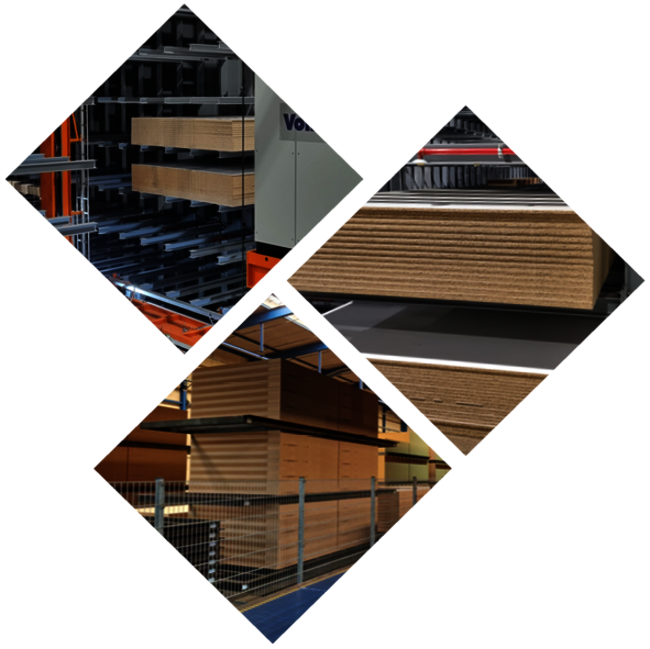
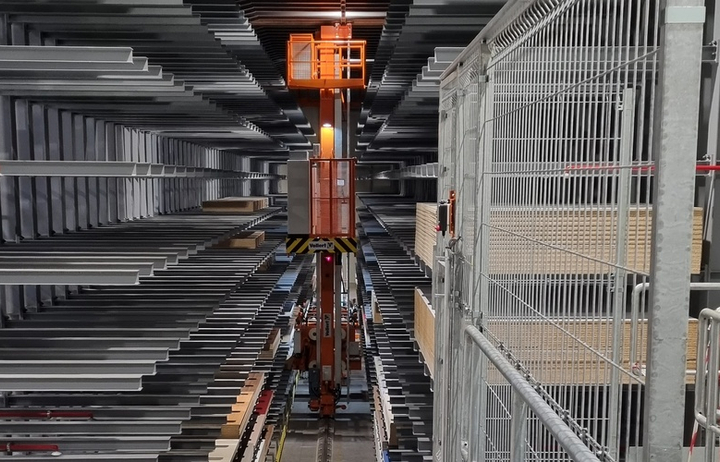
In plants that manufacture particleboard, MDF, and OSB panels, or in furniture production, large stacks of panels that are sensitive to edge damage accumulate—at the press, in temporary storage, and in shipping. Traditional forklift logistics reach their limits here: Space requirements, the risk of damage to edges and surfaces, and limited stacking heights all hinder cost-effectiveness. An automated crane system can store panel stacks more densely and at greater heights than a fleet of forklifts, while simultaneously maintaining a sorted, traceable inventory.
A crane system in the wood industry is rarely an isolated investment. It is part of a production and logistics architecture in which material flow, warehouse logic, process control, and interfaces with adjacent systems must all work together. Anyone who plans only the crane is not thinking far enough ahead. That is why Vollert does not see itself merely as a crane manufacturer, but as an engineering partner that keeps the entire system in view—from the analysis of the material profile and process logic, through the design of load-handling attachments, control architecture, and material flow computers, all the way to integration with WMS and production control. Brownfield situations—the integration of new systems into existing facilities and ongoing operational processes—are also part of our daily project work.