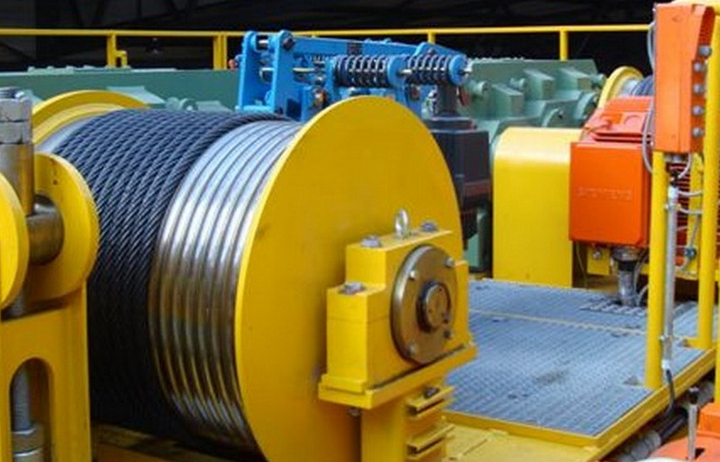
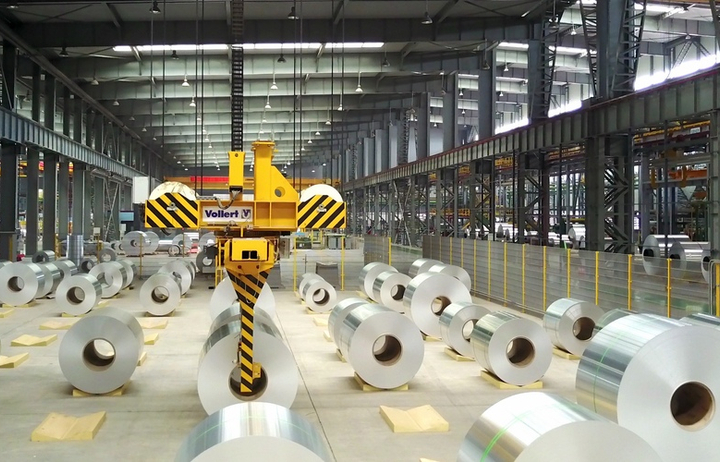
Fully automated rolling mill diening with central coil flat storage at Gränges


Vollert's heavy-duty flat storage systems are designed for applications ranging from 5 to 50 tons and more – wherever massive, large-format, and particularly heavy workpieces need to be handled safely and efficiently. Whether coils, slabs, containers, or other oversized components: Vollert develops flat storage solutions that are designed from the outset as integrated systems: featuring compatible crane and transport systems, automated vehicles, well-thought-out warehouse organization, and clear interfaces with production and IT. The result is warehouses that do more than just store goods—they operate reliably in practice.
Flat storage systems place special demands on planning and design. Precise coordination of statics, material flow, organization, and safety is therefore crucial for economical and permanently safe operation.
Flat storage systems offer particular advantages where floor space is inexpensive, the stored goods are not very delicate, and throughput is generally low. In the heavy-duty sector, this applies to many industries: mechanical engineering, steel processing, the woodworking industry, and the manufacturing of large components.
The open structure allows direct access to the components and offers a high degree of flexibility in warehouse organization. At the same time, even very large or bulky workpieces can be handled with ease. Modern flat storage areas are no longer purely manual storage spaces. Especially in the heavy-duty sector, they are increasingly being combined with automated or process cranes. These systems not only handle storage and retrieval but also internal transport between the warehouse, machining, and assembly areas. Walking and driving routes between loads can be eliminated. This creates a decisive advantage: even without maximum storage density, processes can be highly automated.
Automated crane and handling systems enable reproducible movements with defined speeds and positioning accuracy. This significantly reduces the risk of damage compared to manual operations. At the same time, process quality becomes more consistent as human intervention is minimized.
In heavy-duty intralogistics, floor storage is the most common form of storage for goods that do not fit into conventional racking systems due to their dimensions, weight, or fragility. This is also the case when sufficient floor space is available for storage. Coils, slabs, steel products, building materials, wood-based materials, machine components, or other large parts weighing 5 metric tons or more require a storage environment designed to accommodate their specific characteristics.
The challenges begin right at the floor: High point and line loads require precisely calculated floor load-bearing capacity and a well-thought-out foundation design. At the same time, the space requirements are considerable because, compared to high-rack warehouses, the height of the facility can only be utilized to a limited extent. Block storage without direct access increases the effort required for repositioning and demands smart warehouse organization to minimize search times and unnecessary movements.
Added to this are occupational safety requirements: Heavy, towering, or rolling loads must be reliably secured against tipping, rolling away, and slipping. Without precise coordination of structural engineering, material flow, warehouse organization, and safety technology, operational risks arise that are difficult to correct during ongoing operations.
Automated and process cranes: High-performance crane systems are essential for handling heavy and large-format goods in flat-storage warehouses. Vollert develops automated cranes with lifting capacities ranging from 5 to 50 metric tons that can position loads precisely, grip them securely, and be reliably integrated into automated processes. Special designs for coils, slabs, or pipes are available, as are multi-crane systems for high-throughput requirements.
Automated Mobile Robots (AMR): Automated mobile robots are used where cranes reach their limits or where supplementary transport within the warehouse is required. AGVs handle ground-based transport between storage areas, production lines, and transfer stations—precisely, flexibly, and safely, without manual intervention.
Warehouse organization and control: Block storage without intelligent control leads to high re-stacking costs and long access times. Vollert integrates warehouse management systems that dynamically assign storage locations, can flexibly handle storage location dimensions, optimize access sequences, and provide interfaces to higher-level ERP or MES systems. This transforms a warehouse area into a controlled material flow.
Heavy-duty floor storage systems are not an industry-specific niche solution. They are used wherever goods—due to their mass, shape, or fragility—do not fit on standard shelves and must, at the same time, be closely integrated with production processes.

LOGISTICS AND PRODUCTION SUPPLY
The storage of large-scale goods—for example, in railway maintenance centers where entire bogies are stored on large-capacity load carriers—places special demands on throughput, access speed, and system availability. Even aircraft fuselage sections can be stored space-efficiently without any problems using Vollert storage and retrieval machines. Vollert implements solutions that operate reliably even in 24/7 operation.

WOOD INDUSTRY
Wood-based material stacks, such as large-format laminate panels, MDF panels, or OSB panels, can be efficiently stored in flat-storage systems. Adjustable grippers on the automated crane systems, combined with an intelligent warehouse management system, make it possible not only to store stacks with fixed dimensions but also to flexibly adjust the storage positions to the dimensions of the stacks.

HEAVY MACHINERY MANUFACTURING AND CUSTOM FABRICATION
Large components, housings, turbine parts, rotors, or special components used in mechanical engineering are often manufactured in small batches and must be safely stored between machining steps. This is where the combination of a surface storage system and a process crane is particularly important.
Heavy-duty intralogistics projects are always unique. Different loads, material properties, production processes, and space constraints require customized solutions. Consequently, numerous challenges arise even in the early stages of a project. Below, our experts answer the most common practical questions about heavy-duty floor-level warehouses—based on decades of experience with automated solutions for a wide range of industries.
What load capacities are Vollert flat bearings designed for? What load capacities are Vollert flat bearings designed for?
Vollert shelving systems are designed for heavy-duty applications starting at approximately 5 metric tons and, depending on the specific application, can handle significantly higher loads. The decisive factor here is not just the weight of the stored goods, but the overall design of the system. This includes the floor load-bearing capacity, the sizing of the crane and conveyor systems, the warehouse layout, and the requirements for throughput and access times. Through customized planning, floor storage systems can be optimally tailored to the respective material flows and operational processes. This results in high-performance storage solutions for heavy, bulky, and non-standardized goods.
What types of goods can be handled in a heavy-duty flat storage facility? What types of goods can be handled in a heavy-duty flat storage facility?
Heavy-duty flat-bed storage systems are suitable for a wide range of diverse goods. Typical applications include the storage of steel and aluminum coils, slabs, sheet metal, long materials, wood-based materials, building materials, large containers, and heavy components from the machinery and plant engineering industries. Even particularly large or delicate components can be safely stored and transported. In general, flat-bed storage systems are used wherever weight, dimensions, or material properties make it difficult to use conventional racking systems. The storage and handling technology is customized to the specific goods and process requirements.
In traditional block-style warehouses, accessing specific goods can involve significant re-stacking effort. Vollert addresses this challenge with intelligent warehouse management and material flow solutions. Modern warehouse management systems dynamically assign storage locations, taking into account factors such as turnover rate, production sequence, and shipping dates. In addition, putaway and retrieval strategies are continuously optimized. This helps avoid unnecessary transfers and significantly reduces access times. The result is an efficiently organized open-shelf warehouse with high space utilization, predictable processes, and significantly improved availability of stored goods.
Can an existing flat storage system be retrofitted with automation? Can an existing flat storage system be retrofitted with automation?
Yes. The modernization and automation of existing floor-storage systems is one of Vollert’s core competencies. Many companies already have suitable storage areas but want to make their processes more efficient, safer, and more transparent. As part of a detailed analysis, existing support structures, warehouse geometries, material flows, and operational processes are examined. Based on this analysis, Vollert develops customized automation concepts, for example by integrating crane controls, conveyor systems, or warehouse management systems. The goal is to increase warehouse performance while minimizing downtime during implementation.
Welche Schnittstellen zu übergeordneten IT-Systemen sind möglich? Welche Schnittstellen zu übergeordneten IT-Systemen sind möglich?
Vollert flat-storage systems can be seamlessly integrated into existing IT and automation environments. Depending on requirements, they can be connected to warehouse management systems (WMS), manufacturing execution systems (MES), ERP systems, or higher-level production control systems. The control architecture is individually tailored to the existing infrastructure and takes into account various communication standards as well as industry-specific requirements. This enables the real-time exchange of material movements, inventory levels, and order data. This end-to-end connectivity increases transparency throughout the entire process chain and lays the foundation for efficient, automated, and data-driven logistics processes.