
Shunting solutions
on the spur track
on the spur track

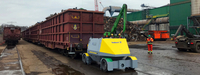
Frustrated by inefficient shunting processes? Our shunting vehicles offer the solution. Maximize the efficiency of your logistics, reduce downtime, and minimize safety risks.
Backed by state-of-the-art technology, our vehicles are designed to optimize your operations.
Finding the right shunting concept
However, choosing a shunting concept depends on many factors and conditions. Cost is another key consideration, but today, no one looks solely at the purchase price anymore. The focus here is primarily on maintenance costs over the entire lifecycle. Explore our selection and let us solve your challenges.

Since the 1950s, stationary, cable-driven shunting systems have been used to move railroad cars and trains. With their compact and robust design, they are built to withstand even the harshest climatic conditions and are frequently used in ATEX zones. We select different systems depending on the specific application.
The small push car or the drive chain are closed cable-pull systems and are permanently positioned along the shunting track. The train is coupled via a stop chain or a ball bar. For through tracks, a shunting system with wheel set push trolleys is recommended so that the track remains clear for traffic when the push rollers are retracted. The push rollers can engage with any axle. This enables flexible, fully automatic operations.
For dead-end tracks, a shunting system with standard-gauge push cars is often used. Here, heavy trains with a total weight of up to 4,000 tons can be moved. As an additional option, the push car can extend laterally so that the track remains clear for through traffic.

Compared to stationary shunting systems, the shunting robot is a solution that does not rely on switches or tracks. It can easily move loads of up to 8,000 tons, and thanks to its low purchase and inspection costs, this solution offers an alternative to large shunting locomotives. A variety of drive technologies are available.

Road-rail vehicles are the ideal solution for light shunting operations. They are battery-powered and therefore operate with zero emissions. Using a radio remote control, you can quickly and easily switch from the tracks to the road. Thanks to their high maneuverability and compact design, road-rail vehicles are the ideal solution for any situation where you need to shunt quickly and efficiently across multiple tracks.
Digital solutions open up new possibilities in shunting technology. Smart features enhance transparency, efficiency, and safety in operations—and make shunting processes ready for the future.
Precise positioning of railcars
To position railcars precisely, stationary sensors on the track are used today. Alternatively, an absolute or incremental encoder mounted on an additional slip-free wheel is employed. This serves both to record the current speed and as a position measurement system, for example in railcar synchronization. However, a measuring wheel can also be used for slip detection by comparing the actual and target speeds. If there is a significant difference between the actual and target values, sand is scattered between the wheel and the rail to influence the coefficient of friction.
To detect obstacles or to increase safety, the track can be monitored by radar or laser scanners. Scanners can also be used for distance detection, such as during autonomous coupling.
Customized customer interfaces
Another smart feature is the integration of custom interfaces. This makes it easier to integrate modern shunting systems into customers’ central loading control systems. In addition to travel speed, signals to be exchanged often include travel clearances or restrictions. Signal and video transmission is now possible not only via radio but also via a Wi-Fi connection. In drive technology with cable reels, signal transmission can take place via an integrated optical fiber. This allows for the transmission of many more signals and higher data rates.


