Heavy-duty
transport cart
transport cart

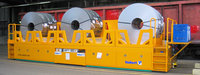
Moving heavy loads within a facility is a matter of the route taken. Anyone who transports coils, slabs, or scrap baskets at regular intervals between the warehouse, furnace, rolling mill, or further processing facilities needs a system that transfers the load to the floor in a controlled manner, always follows the same route, and stops at the same position at every transfer point. This is exactly what a rail-guided transport vehicle does: The route is fixed, the transfer points are clearly defined, and the process can be secured and automated.
Vollert supplies and installs rail-guided transport vehicles and heavy-duty manipulators for the in-plant transport of heavy loads—for steel and metallurgical plants or the aluminum industry. Transport vehicles with load capacities of up to 300 metric tons for scrap baskets, slabs, or coils are just as much a part of the product line as complex automation systems. The systems are integrated on-site into the production facility using the control system developed by Vollert.
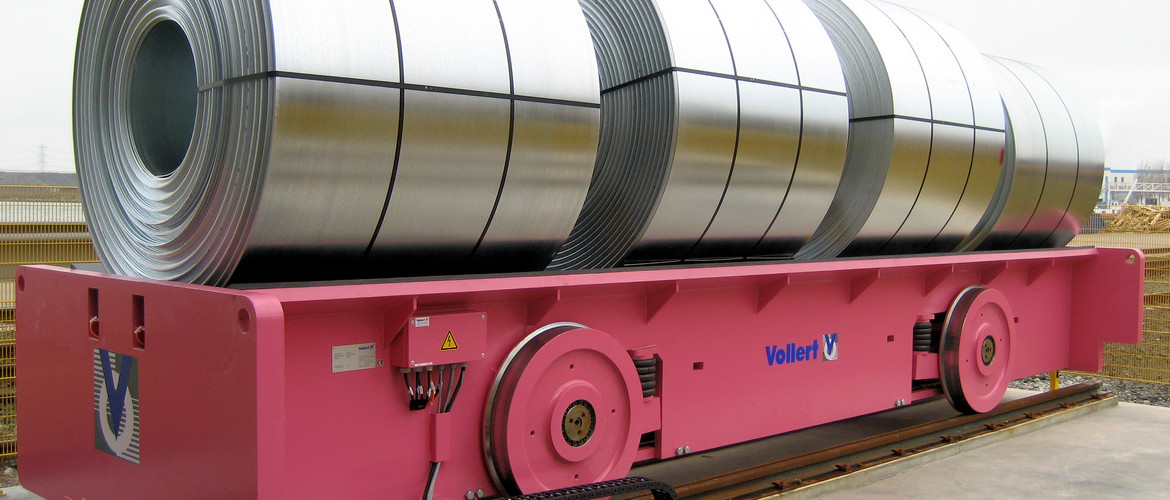
Heavy-duty transport carts connect process steps between which heavy goods are moved at regular intervals. They transfer weight and point loads via rails and foundations, rather than distributing them across the entire floor of the facility. Added to this are the conditions of the heavy-duty environment: heat near furnaces and foundries, scale, dust, and dirt; tight facility layouts; and route intersections with personnel or other vehicles. A fixed route makes such situations predictable: safety zones, intersections, and handoffs are defined once and apply to every trip.
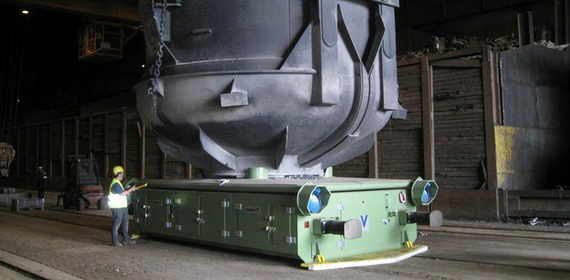
STEEL AND METALLURGICAL PLANTS
Scrap baskets and slabs are among the heaviest single loads in intramural transport. They are moved between the scrap yard, the furnace, the continuous casting line, the warehouse, and further processing—in an environment characterized by high temperatures, scale, and dirt, all of which must be taken into account in the design and drive system.
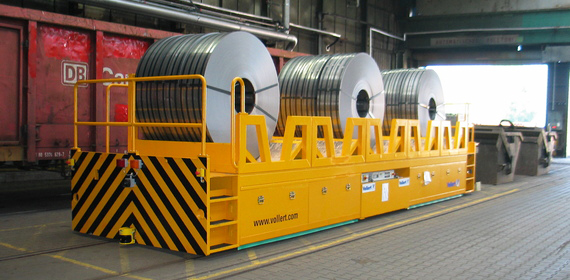
ALUMINUM INDUSTRY
Coil transport carts connect high-bay warehouses, rolling mills, and cutting lines to form an automated material flow. Inductively powered coil transport carts travel contactlessly and without a drag chain between the high-bay warehouse and the rolling mill—including intersections with the existing roll-change cart and plant personnel.
A transport cart is always part of a material flow. That is why Vollert designs heavy-duty transport carts as part of the overall material flow: transfer points to cranes, storage and retrieval machines, or production lines are systematically defined, and route intersections and safety zones are planned from the outset. Vollert develops the control system in-house and uses it to integrate the system on-site into the production environment—including into existing control systems. In brownfield projects, this integration capability is crucial to success: existing tracks and foundations, hall columns, ongoing processes, and existing control systems must be taken into account from the very beginning. A team of technicians and engineers is available worldwide to support these efforts.
At its core, a heavy-duty transport vehicle consists of a support frame, chassis, drive system, power supply, load-bearing mechanism, and control system. The appropriate design is determined not by the product category, but by the interplay of load, route, environment, and transfer points. Various questions and considerations must be clarified in advance:
What loads, dimensions, and materials need to be moved—and how hot or sensitive are they?
What is the route like: linear, with intersections, indoors, or outdoors?
What cycle time and throughput are required?
What transfer points are involved—crane, stacker crane, roller conveyor, machine?
What interfaces exist with existing control systems?
Is this a new installation or an expansion during ongoing operations?